Mine à ciel ouvert Goitzsche, Open-pit lignite mine in Anhalt-Bitterfeld, Germany.
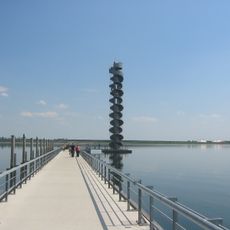
The Goitzsche opencast mine is a former lignite extraction site in Anhalt-Bitterfeld with exposed earth layers showing different geological formations. The pit shapes the local landscape and is now used for recreation and environmental learning.
Large-scale lignite mining at Goitzsche began in 1948/49, and the first coal train left in 1952. The opencast mine closed in 1991 after German reunification cut demand for lignite. From 1991 to 1998 the LMBV moved about 56 million m³ of spoil over roughly 830 hectares as part of rehabilitation.
The name Goitzsche comes from the alluvial forest that once stood here. Mining displaced about 3,800 residents of Paupitzsch, Niemegk, Döbern, Seelhausen and parts of Petershausen and Sausedlitz, whose villages were then excavated. From 1975 to 1990, about 50 tonnes of amber a year were extracted from the pit, over 400 tonnes in total, mainly for the jewellery industry.
The former pit is now a lake landscape: the Große Goitzschesee in the north, fed since May 1999 with water from the Mulde, and the Seelhausener See in the south on the Saxony-Anhalt/Saxony border. Paths and cycle routes circle the water; the flooded slopes are former mining embankments, so stay on marked trails.
Between 1975 and 1990, more than 400 tonnes of amber were extracted here, about 50 tonnes a year, and the material went mainly to the jewellery industry. The Bitterfeld amber deposit in the Goitzsche pit was discovered in 1955, and geological exploration began in 1975.
The community of curious travelers
AroundUs brings together thousands of curated places, local tips, and hidden gems, enriched daily by 92,638 contributors worldwide.