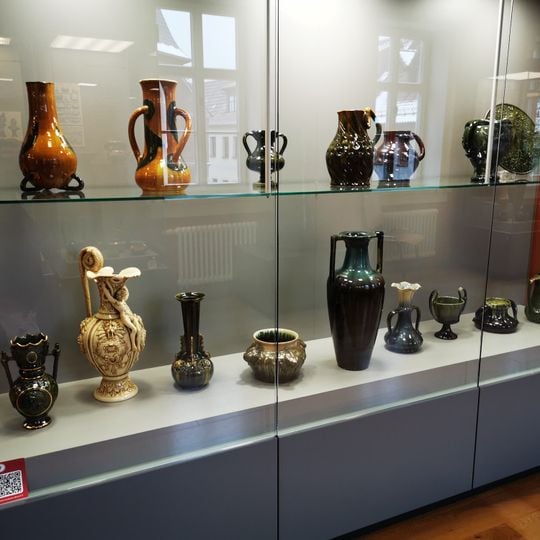
Keramikmuseum Bürgel, Ceramics museum in Bürgel, Germany
The Keramikmuseum Bürgel displays collections of traditional and contemporary ceramics from various periods, showing how pottery techniques developed across the region. The exhibitions showcase both historic local craftwork and modern creations side by side.
Bürgel's potters are documented from the mid-17th century; in 1660 several craftsmen's families joined a cooperative corporation, attested by a founding document, a guild chest and a flag. Grand Duke Carl Alexander of Saxe-Weimar-Eisenach had the sculptor Georg Kuhla of Ruhla reorganise the former school in 1879, and the 1880 trade exhibition "Früchte des Wirkens" became the museum's founding stock.
The blue colour typical of Bürgel ware came from firing in a wood-fired Kasel kiln; the last such kiln, used until 1953, stands very close to the museum. The collection also holds the guild's founding document, chest and flag from 1660, when several potter families joined into a cooperative corporation.
Visitors can take pottery workshops year-round, explore rotating exhibitions, and buy ceramic works at the museum shop. Workshop spaces are accessible during regular hours, though advance registration is typically needed for hands-on classes.
The museum's collection began with the 1880 trade exhibition "Früchte des Wirkens", organised by the local trade association. Grand Duke Carl Alexander of Saxe-Weimar-Eisenach had commissioned the sculptor Georg Kuhla of Ruhla in 1879 to reorganise the former school building, which allowed the pottery trade to gain new prospects. Pieces by master potters such as C.A. Schack and Max Neumann were shown there.
The community of curious travelers
AroundUs brings together thousands of curated places, local tips, and hidden gems, enriched daily by 93,799 contributors worldwide.