Rathaus Wilhelmshaven, City hall in Wilhelmshaven, Germany.
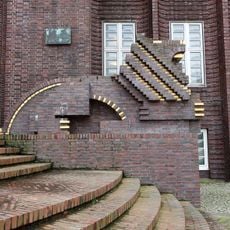
Rathaus Wilhelmshaven is the municipal administration building standing at 48 meters tall with geometric forms and a striking red brick exterior in the Brick Expressionist style. The facade displays clean lines and prominent vertical elements that make it recognizable from various points in the city.
Plans for a new town hall for Rüstringen began before World War I; after four competitions, Fritz Höger won in 1926. The foundation stone was laid on 4 May 1928, and the building was inaugurated on 11 October 1929 after 77 weeks of work, with 73 firms involved. Bomb hits on 15 October 1944 set it ablaze and nearly destroyed the east wing; it regained its old form in 1952–53.
The building serves as the civic center where the city's administrative work happens and where residents come for official matters. Its strong brick facade has become a recognizable symbol for people navigating the city center.
The building sits centrally in Wilhelmshaven and is easily reached by walking through the city center from main streets and squares. Keep in mind that it is an active government workplace, so some interior spaces may have restricted access for official business.
The tower that gives the building its height was not built for offices: it holds a water tank, replacing a freestanding water tower. The empty space beneath the tank could be used for other purposes. Höger was not the first to combine a water tower with an administrative building; the Rathaus Neuenhagen bei Berlin by Wilhelm Wagner, completed in 1926, and the Wohnwasserturm Wulsdorf by Heinrich Mangel, built in 1927, came earlier.
The community of curious travelers
AroundUs brings together thousands of curated places, local tips, and hidden gems, enriched daily by 92,792 contributors worldwide.