Schloss Wörlitz, Classical palace in Wörlitz, Germany
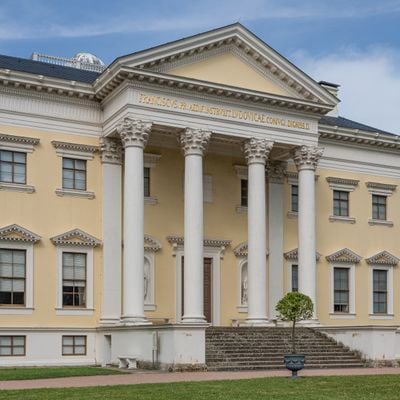
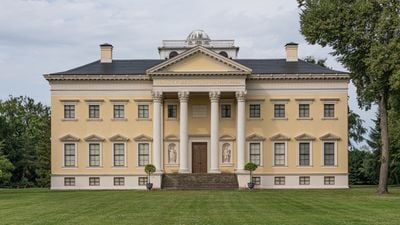
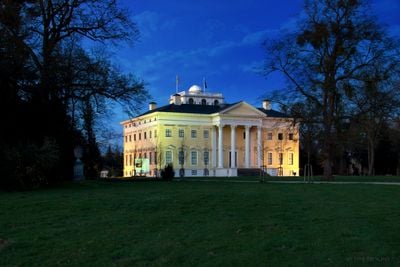
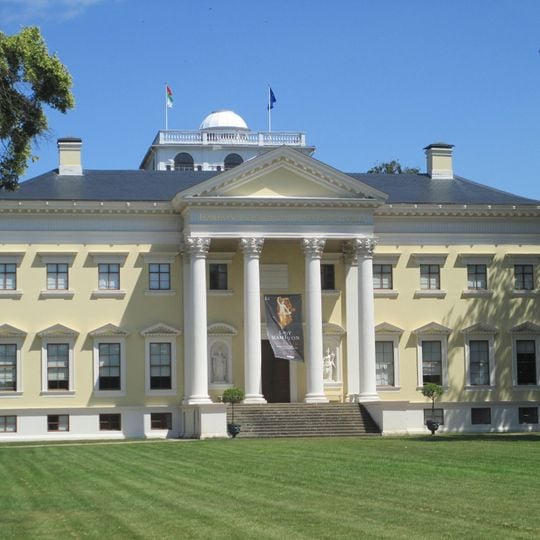
Schloss Wörlitz is a two-story palace with a pale yellow facade and white trim, its central section projecting under a triangular pediment inscribed "FRANCISCVS PRINCEPS ANHALTINVS." Four white columns support the pediment above a wide flight of gray stone steps. The dark gray hipped roof carries two chimneys, and a white balustrade with a dome and two flags rises above the roofline.
Prince Leopold III Friedrich Franz von Anhalt-Dessau had the Baroque hunting lodge on the site demolished and commissioned Friedrich Wilhelm von Erdmannsdorff to build the palace, completed in 1773 for the prince and his wife Luise of Brandenburg-Schwedt. Modelled on Palladio and English country houses, it is regarded as the founding building of German Classicism.
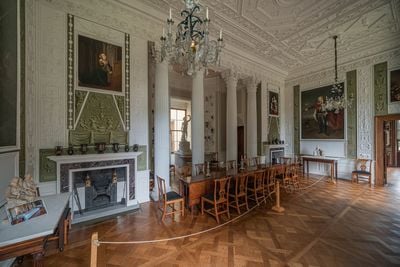
The palace holds paintings by old masters, a collection of antiquities and a ceramics collection consisting mainly of replicas of ancient works from Josiah Wedgwood's porcelain factory. Much of the original furniture comes from the workshop of Abraham and David Roentgen. The dining room has four Corinthian columns, and the Belvedere contains the Palmensaal.
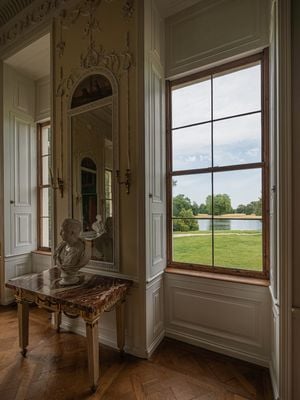
The palace is shown only on guided tours; the kitchen building about 50 metres to the south-west, linked to the house by an underground passage since its construction in 1770–1772, now serves as a restaurant. The rear facade faces the Wörlitzer See and is visible from the opposite shore in front of the town skyline.
The palace kept its 18th-century technical fittings: cast-iron stoves, folding wall beds, a water pump feeding the upper floor, an ice cupboard, dinner lifts and disappearing doors. A bathroom made for the princely couple was later removed. A kitchen building about 50 metres to the south-west has been linked to the palace by an underground passage since it was built in 1770–1772.
The community of curious travelers
AroundUs brings together thousands of curated places, local tips, and hidden gems, enriched daily by 92,911 contributors worldwide.