Burg Leonberg, Medieval castle in Maxhütte-Haidhof, Germany.
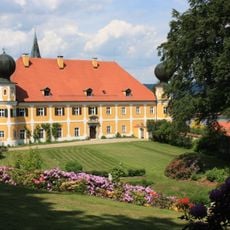
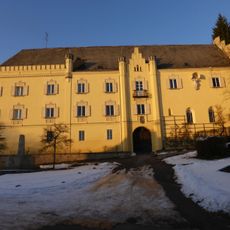
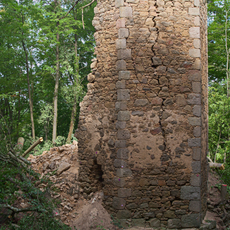
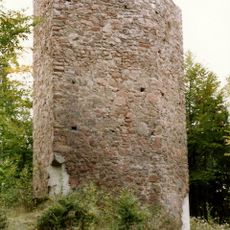
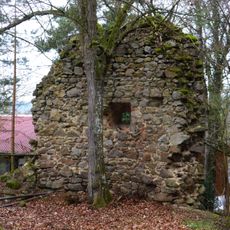
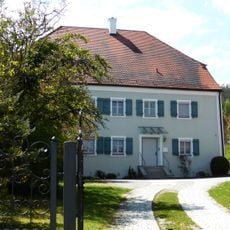
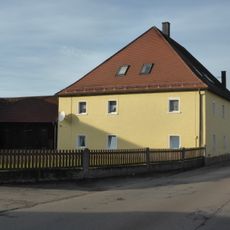
Burg Leonberg, also called Altes Schloss or Gschlössl, stands at the highest point of Leonberg in Maxhütte-Haidhof. The irregular building complex dates from the 14th and 16th centuries and consists of a north-side tower with a saddle roof, stepped gables and a volute gable, flanked by two residential buildings. Of the former four round towers, two are partly visible; the former perimeter wall and moat are only hinted at, and the southwest wall ring is now integrated into the residential building.
In the 13th and 14th centuries the castle was the seat of the Limperger family; a 1378 document calls it the Veste zu dem Liemperg, held by Chaloch Hofer and then the Losnitzer. The Sinzenhofer followed, with Ludwig von Sinzenhof named in 1422 and Hans Gnädendorfer in 1429. In 1603 the estate passed from Georg Leo von Sinzenhof to Wolfgang Teufel von Pirkensee. The castle was destroyed in the Thirty Years' War and only the main building was rebuilt; the owners moved to other castles while the estate administration stayed in Leonberg. In 1796 Wilhelm Carl Freiherr von Eckart acquired castle and Hofmark; after the new castle was built in 1890 the old castle was converted into flats.
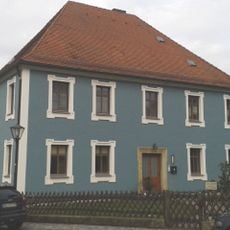
Locals call the building Gschlössl, a diminutive of Schloss, and it is still inhabited: the former castle is divided among seven owners and used as flats. The name Altes Schloss distinguishes it from the new castle built in 1890, after which the owners abandoned the hilltop.
The castle stands at the highest point of Leonberg, at Burgweg 5, and is visible from afar. It is a privately owned building divided among seven owners and used as flats, so it can only be viewed from outside; the former ring wall and moat are barely traceable, while the southwest wall circuit is built into the residential wing.
The castle once had four round towers; only two are still partly visible today. The former massive perimeter wall and the moat can only be guessed at, and the southwestern wall ring is now built into a residential building. The so-called Gschlössl is inhabited and belongs to seven owners.
The community of curious travelers
AroundUs brings together thousands of curated places, local tips, and hidden gems, enriched daily by 92,787 contributors worldwide.