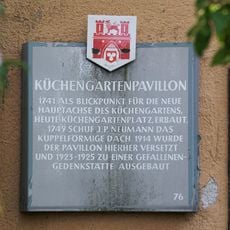
Küchengarten-Pavillon, Architectural heritage monument in Linden-Limmer, Germany.
The Küchengarten-Pavillon is a slender belvedere on a square plan, with a lower storey and a tall domed upper storey held together by pilasters, flanked by two low balconies. The rendered brick building is articulated with sandstone and topped by a slate-covered dome added in 1749. It stands on the highest point of the Lindener Berg cemetery, reached by an avenue from the cemetery's main entrance, the former Küchengarten portal moved here in 1937.
The Küchengarten in Linden was completed by 1654 as a kitchen garden for the Hanover court. In 1748–1749, court architect Johann Paul Heumann built the pavilion as a pleasure house in the garden's north wall; its slate dome was added in 1749. After the garden was dissolved in 1866, the pavilion served as a weather shelter on the goods station. It was demolished in 1911 and rebuilt in 1913 on the highest point of the Lindener Berg cemetery. From 1919 to 1967 the upper floor housed a memorial for fallen Linden soldiers.
The building began as a garden structure for the royal kitchen gardens and transformed its role several times over the centuries. Today visitors can trace these changes through the artifacts and documents displayed inside.
The building sits within the cemetery grounds and is most easily reached by following the main pathways that ascend through the site. Visitors should note that access may vary depending on weather conditions and the season, so sturdy footwear is advisable.
The pavilion was demolished in 1911, then rebuilt in 1913 on the highest point of the Lindener Berg cemetery. Its old garden portal had already been moved up the hill in 1937 and now forms the cemetery's main entrance, with an avenue running straight to the pavilion.
The community of curious travelers
AroundUs brings together thousands of curated places, local tips, and hidden gems, enriched daily by 92,641 contributors worldwide.