Schloss Eurasburg, Renaissance castle in Eurasburg, Germany.
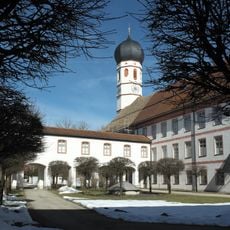
Schloss Eurasburg is a two- to three-storey three-wing building with plaster detailing in late Renaissance forms, built 1626–1630 and attributed to Peter Candid. A projecting central tower and flanking onion-domed towers rise above white walls under a steep red pantile roof; the ground floor of the right wing has tall windows in arched red brick surrounds. A two-storey neo-Baroque outbuilding with an onion-domed corner tower dates from 1905.
The castle was originally known as Iringsburg and belonged to the Iring family before being demolished in 1626 by Duke Albrecht VI of Leuchtenberg and rebuilt in Renaissance style. A fire in 1976 led to restoration work that brought the structure to its present condition.
The name Iringsburg recalls the Iring family, whose Hofmark seat stood on the Tischberg above the Loisach valley before Duke Albrecht VI of Leuchtenberg had it demolished in 1626. The present late-Renaissance building, attributed to Peter Candid, was erected between 1626 and 1630. A neo-Gothic remodelling followed in 1866, and the original state was restored in 1908.
The castle is now divided into several private residences, so visiting the exterior is the best option for travelers. Access to the site is through the regular paths that lead to the building.
Hermann von Barth, a noted mountaineer of the 19th century, was born at the castle in 1845. His later achievements in alpine climbing added to the historical profile of the place.
The community of curious travelers
AroundUs brings together thousands of curated places, local tips, and hidden gems, enriched daily by 92,729 contributors worldwide.