Evangelische Kapelle, Protestant chapel in Bad Salzhausen, Germany
The Evangelische Kapelle is a Protestant chapel in Bad Salzhausen, a spa village that is part of the town of Nidda in the German state of Hesse. The building is also listed as a cultural heritage monument in Germany, which means it is officially protected alongside its ongoing religious use.
Built in 1828 as a neoclassical rectangle, the building served Justus von Liebig as a laboratory and hydrochloric acid factory from 1828 to 1831. It stood empty from 1831 and was later used as a storage room and fire brigade shed. From 1934 the western part was used as a chapel by the Protestant Lutheran church of Nidda, and from 1969 to 1971 it was converted into a church.
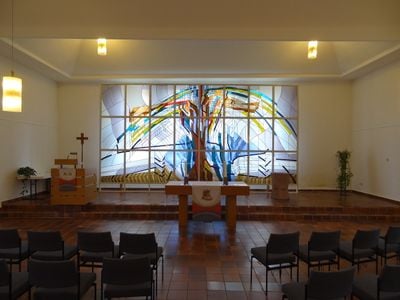
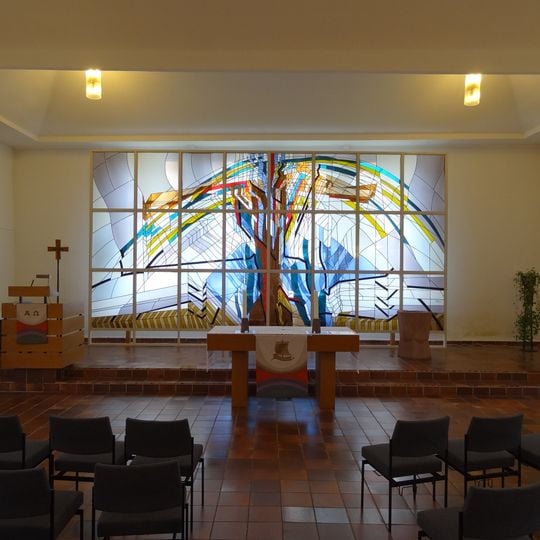
The chapel's stained glass, made in 1994 by Nidda-born artist Diether F. Domes, carries the colours of the spa: blue stands for the healing springs as well as health and baptism, brown for earth and creation, yellow for light and resurrection, red for love and the blood of life. Four leaded windows in the upper vestibule, dating from 1934, show the coats of arms of Ludewig Knott, Roland Krug von Nidda, Johann Wilhelm Langsdorf and Julius Liebig.
The chapel stands on the southern edge of Bad Salzhausen, not in the centre. The entrance is reached from the street side; inside, the altar area in the southwest is raised two steps above the brown tiled floor. The 24-field glass wall stands in front of the four narrow windows of the southwest wall.
The building began in 1828 as a laboratory and hydrochloric acid factory run by Justus von Liebig from 1828 to 1831. There he unknowingly encountered bromide, which he took for "hydroiodic sodium". The upper-floor vestibule keeps four 1934 stained-glass windows with the coats of arms of Ludewig Knott, Roland Krug von Nidda, Johann Wilhelm Langsdorf and Julius Liebig.
The community of curious travelers
AroundUs brings together thousands of curated places, local tips, and hidden gems, enriched daily by 93,668 contributors worldwide.