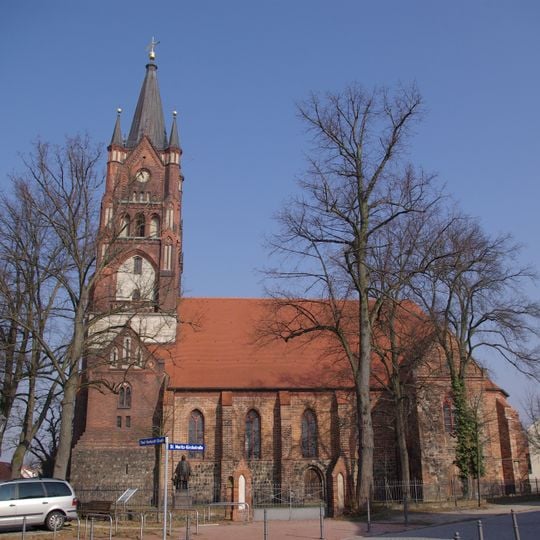
Stadtpfarrkirche St. Moritz, Gothic church in Mittenwalde, Germany
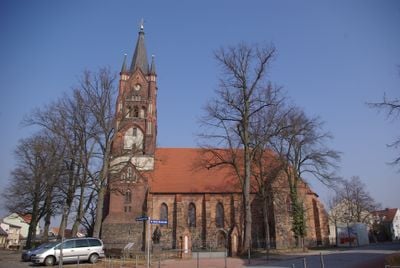
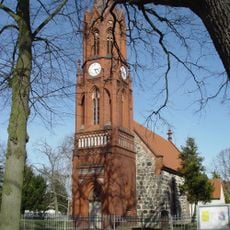
St. Moritz is a brick Gothic hall church in Mittenwalde with a tall west tower topped by a dark pointed spire with a cross, pinnacles, a clock, and arched openings. The long body has tall arched windows between brick buttresses, a lower aisle on the right, and rough fieldstone lower walls. The tower's neogothic design dates from 1877/78 by Johann Eduard Jacobsthal.
Mittenwalde's church began in the 13th century as a Romanesque fieldstone building with a west tower. In the 14th century it was rebuilt as a three-aisled Brick Gothic hall church with star vaults, reusing parts of the Romanesque masonry. An ambulatory choir was added in the early 15th century, and the church became Lutheran in 1539. The neo-Gothic tower was built in 1877/78 to designs by Johann Eduard Jacobsthal.
The church is named after Saint Maurice, patron saint of the Holy Roman Empire since Otto I transferred his relics to Magdeburg. Its late-Gothic carved altar dates from 1514, and the choir stalls hold 45 carved panels from the mid-16th century. A wooden memorial tablet for Paul Gerhardt's daughter Maria Elisabeth, who died in 1657, hangs inside.
The church remains accessible year-round and is used for religious services with visitors welcome to enter. Best explored during daylight hours to fully see the interior stonework and windows.
The four cast-iron bells in the west tower were all made in 1956 by Schilling & Lattermann and hang on cranked yokes; they sound the notes f′–as′–b′–des″, known as the Parsifal motif. The church also keeps the wooden grave tablet of Paul Gerhardt's first daughter Maria Elisabeth, who died in Mittenwalde on 14 January 1657.
The community of curious travelers
AroundUs brings together thousands of curated places, local tips, and hidden gems, enriched daily by 93,972 contributors worldwide.