Gänstorbrücke, Road bridge between Ulm and Neu-Ulm, Germany
The Gänstorbrücke is a prestressed concrete road bridge over the Danube linking Ulm and Neu-Ulm, designed by Ulrich Finsterwalder and completed in 1950. It is 18 m wide with four lanes and 3 m sidewalks on each side. Its two mirror-symmetric halves are separated by a joint, visible from the bank path beneath the 81.30 m span.
The current bridge was built in 1950 as one of Germany's earliest prestressed concrete structures designed by engineer Finsterwalder. It replaced an older crossing and has undergone modernization to meet increasing traffic demands over the decades.
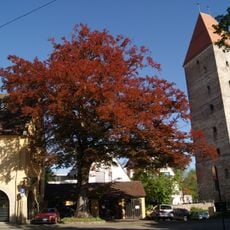
The name Gänstorbrücke comes from the historic Goose Gate, an old city entrance in Ulm that gave this bridge its name. Today it serves as a daily crossing for people moving between the two cities for work, shopping, and daily activities.
Since 2018 the bridge has been partly closed because of progressive damage; from 2023 until probably 2027 it is being demolished and rebuilt, with one half kept open to traffic at a time. The two halves are separated by a joint, visible from the bank path beneath the arch. The structure is 18 m wide, with four lanes and 3 m footways on each side.
The bridge is actually two mirror-symmetric prestressed concrete structures standing side by side, separated only by a joint. From the bank path beneath the arch, this seam is visible; from above it is covered by a 60 cm wide suspended slab. Its slenderness ratio of 1830 exceeds that of the 1934 Europabrücke in Koblenz.
The community of curious travelers
AroundUs brings together thousands of curated places, local tips, and hidden gems, enriched daily by 92,655 contributors worldwide.