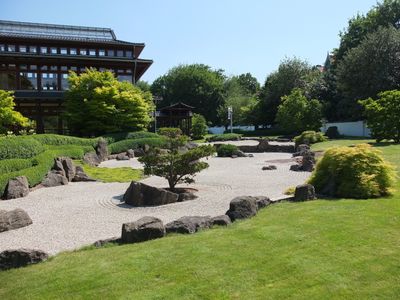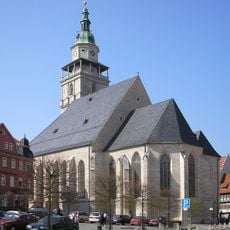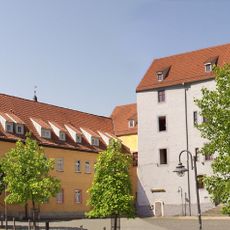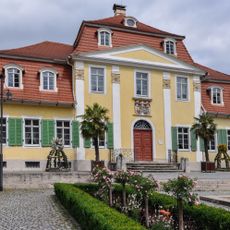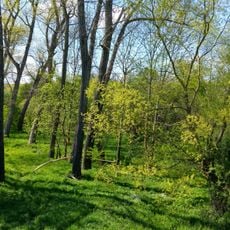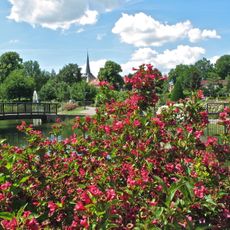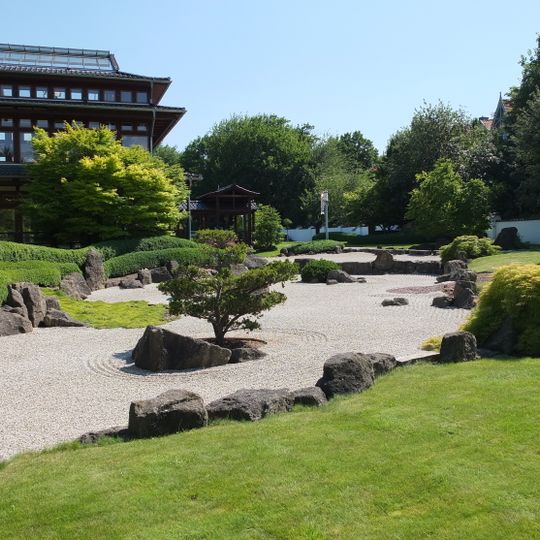
Japanese garden, Japanese garden in Bad Langensalza, Germany.
The Japanese garden in Bad Langensalza, called Kōfuku no niwa (Garden of Bliss), is a modern stroll garden on a rectangular plot of about 120 by 60 metres. Its northern half holds a dry karesansui garden of light gravel raked into lines, with two small islands shaped as a crane and a turtle; the southern half surrounds a pond with a flat-roofed snow-viewing stone lantern, a zigzag bridge over irises, a cherry garden and a bamboo grove.
In 1999 Bad Langensalza sought a garden theme for its spa guests, and the idea of a Japanese garden arose. Construction of the building complex began in autumn 2001; in autumn 2002 landscape architect Silke Hasskerl-Schilling, who had experience in Japan, designed the garden. It opened in August 2002 as Kōfuku no niwa, the Garden of Bliss.
The garden's name, Kōfuku no niwa ("Garden of Bliss"), is used for seasonal festivals held during the March–October opening: Hanami for the cherry blossom in April, a fairy-tale festival in June, and Tanabata in July. In December 2025, during the usual closure, a first "Far Eastern light poetry" event lit the garden in changing colours with two video projections and music.
The garden is open from March through October and can be explored on foot with generally accessible pathways throughout. Visitors should plan to explore during daylight hours and wear comfortable walking shoes since there are multiple paths and stone bridges crossing the ponds.
The zigzag bridge over the pond's western third is a yatsubashi, a bridge type named for its eight planks; iris grows along its sides. The garden also holds a stone Buddha in the azalea garden, won by Bad Langensalza in a town competition and not typical of Japanese gardens, plus three old bonsai from the city's collection to its right.
The community of curious travelers
AroundUs brings together thousands of curated places, local tips, and hidden gems, enriched daily by 94,032 contributors worldwide.