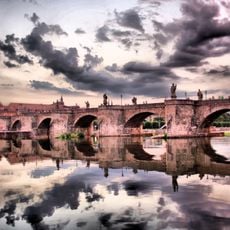
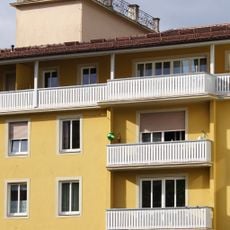
Rathaus, Town hall complex in Würzburg, Bavaria, Germany
The Rathaus is a complex of connected buildings in Würzburg's old town, entered through the Grafeneckart, the city's oldest surviving Romanesque secular building, and the adjoining Roter Bau. The Roter Bau, finished in 1659 to a design by master stonemason Sebastian Villinger, has a marked gabled facade whose arcades carry keystone faces carved by Johann Philipp Preuß. The complex can be crossed from the Grafeneckart through to the Rückermainstraße.
The Grafeneckart, the oldest surviving Romanesque secular building in Würzburg, was acquired by the town's citizens in 1316 and used as the town hall. In 1456 its tower received a fire and hour bell and a clock. The complex was rebuilt between 1898 and 1900 and extended in 1904/1905, destroyed in the Second World War and reconstructed in the early 1950s.
The new council hall on the first floor of the south wing carries wall frescoes by Wolfgang Lenz showing scenes from Würzburg's history. In the arcades of the Roter Bau, carved keystone faces made in 1659 by sculptor Johann Philipp Preuß of Erbach can be spotted, and remains of Prospero Brenno's 1672 stucco decoration survive in that building's hall.
The complex runs from the Grafeneckart on Beim Grafeneckart through to Rückermainstraße 2, so you can walk straight through it. The documentation room on the 1945 bombing, with its model of the destroyed old town, is on the ground floor of the Grafeneckart building.
The Kellerbau (Kalterhaus) north of the Grafeneckart encloses the cross-ribbed vaulted former council chapel of 1399; it now forms part of the Ratskeller restaurant, which was built from 1912 and opened on 31 January 1918, then restored in 1973 after the 1945 bombing.
The community of curious travelers
AroundUs brings together thousands of curated places, local tips, and hidden gems, enriched daily by 94,002 contributors worldwide.