Hauptfriedhof Kaiserslautern, Cultural heritage cemetery in Kaiserslautern, Germany.
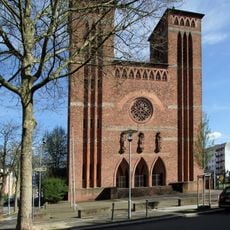
Hauptfriedhof Kaiserslautern is a cemetery laid out like a formal park with straight paths crossing perpendicular to each other, all shaded by mature trees. The grounds are organized into distinct burial sections, with a central chapel serving as the main architectural feature on the site.
The cemetery opened in 1874 as a replacement for an earlier burial ground that had become too small to serve the growing city. A chapel was constructed in the early 1900s to serve as a central meeting point and place of reflection for the community.
The cemetery's name refers to its role as Kaiserslautern's main burial ground, and the oldest section, laid out between 1874 and 1918, is a protected monument enclosed by a sandstone wall. North of the Jewish cemetery lies an Ehrenfeld for prisoners of the Franco-Prussian War of 1870/71, marked by cast-iron crosses on sandstone bases and a Germania statue carved by Jakob Menges in 1878.
Public buses serve the cemetery with stops near the main entrances, making it straightforward to visit by public transportation without a car. The clearly marked pathways and open layout make it easy to navigate and find your way around the grounds.
A lion fountain with four sculpted lions holding shell-shaped basins stands on the grounds as an unusual water feature that many visitors pass without noticing. This ornamental work was added after the First World War and reflects how communities marked their periods of collective loss.
The community of curious travelers
AroundUs brings together thousands of curated places, local tips, and hidden gems, enriched daily by 92,644 contributors worldwide.