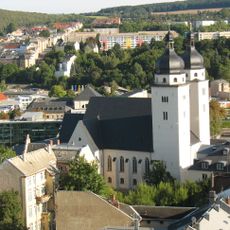
Castle of Plauen, Medieval castle ruins in Plauen, Germany.
Schloss Plauen, also called the "Castle of the Vögte", is a castle complex of which only remnants survive on the Schlossberg in Plauen. The hilltop castle was begun around 1250 as the seat of the Vögte of Plauen. Excavations from March 2014 showed that the partly preserved ring wall had a triangular ground plan from the outset.
The fortress was built in the Middle Ages to control Plauen and the surrounding Vogtland territory, and served as the seat of the local rulers known as the Vögte of Plauen. After fires and military conflicts over the following centuries, it was gradually abandoned and fell into ruin.
The castle's name, "Schloss der Vögte" (Castle of the Vögte), refers to the Vögte of Plauen, who built it around 1250. The Vogtland region is named after the Vögte of Weida, not this castle. After 1718 the rebuilt castle served as an administrative and judicial seat, and from 1852 as a prison until the cell blocks were demolished in 2013.
The site is reachable on foot from the town center via marked paths that climb up the hill. The ground around the ruins is uneven in places, so sturdy footwear makes the visit more comfortable.
The name Vogtland comes from the Vögte of Weida, not from this castle: the region was named after them before the Plauen line split off around 1244. The castle itself was probably built by Henry I of Plauen on a spur overlooking the 1244 stone bridge over the White Elster.
The community of curious travelers
AroundUs brings together thousands of curated places, local tips, and hidden gems, enriched daily by 92,642 contributors worldwide.