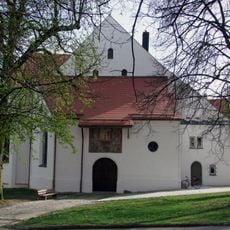
Synagoge, Jewish religious building in Memmingen, Germany.
The Memmingen Synagogue was a new building completed in 1909 to designs by the Frankfurt architect Max Seckbach, who led the construction. At the congregation's request its exterior resembled a Baroque church rather than the neo-Moorish style then usual for Jewish sacred buildings, with modern details loosening the facade. It stood on the Bismarckstraße, on the garden plot outside the former town wall, beside a converted community house.
The building was constructed in 1909 according to designs by architect Max Seckbach and served the local Jewish community for several decades. It was destroyed in 1938 during the November pogrom, marking a tragic chapter in the city's history.
The synagogue served as a gathering place where Memmingen's Jewish community came together for worship and to maintain their religious traditions. The space reflected values that shaped how members of this community lived their daily lives.
The building was located near the city center of Memmingen and was easily accessible. Visitors can explore the site today on foot and learn more about local history through memorials or information plaques in the area.
The synagogue was the second-to-last new synagogue built in Bavarian Swabia, after Nördlingen (1886) and before Augsburg (1914/17). Its architect Max Seckbach, from Frankfurt am Main, was the first known Jewish master builder to realise such a project in the region. The community had bought the Kohn property for 36,000 marks in March 1908.
The community of curious travelers
AroundUs brings together thousands of curated places, local tips, and hidden gems, enriched daily by 93,404 contributors worldwide.