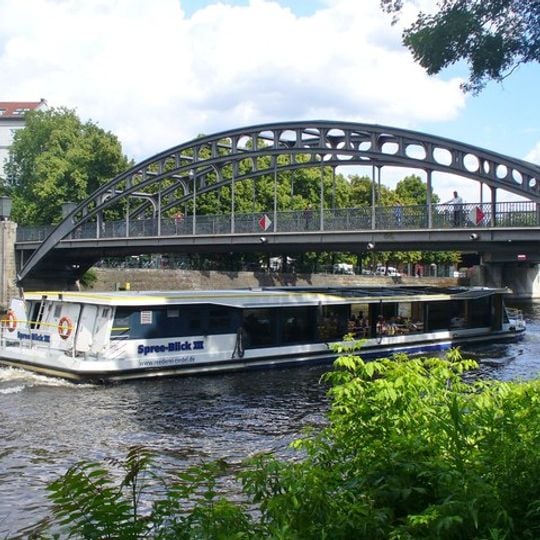
Gerickesteg, Steel arch footbridge in Moabit, Germany.
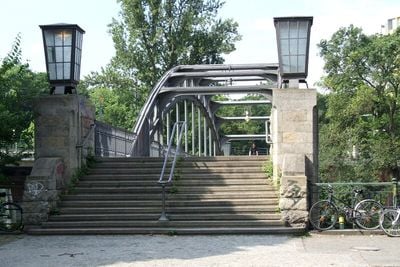
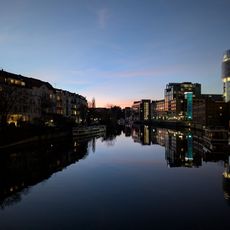
Gerickesteg is a steel footbridge over the Spree between Helgoländer Ufer and Holsteiner Ufer, east of Bellevue S-Bahn station. Its two sickle-shaped arch girders have a 52-metre span and pierced circular and oval openings; the five-metre walkway hangs low within the arches, leaving four metres of clearance for boats. The arches are solid at the ends and open Vierendeel girders at midspan.
The Gerickesteg was built from October 1913 and opened on 30 January 1915, replacing the pedestrian path on the 1880s Stadtbahn railway bridge; it was designed by Bruno Möhring with engineers Friedrich Krause, Fritz Hedde and Emil Usinger. In 1920 it was renamed after Moabit city councillor Wilhelm Gericke. German troops blew it up at the end of the Battle of Berlin; the southern end was lifted from the Spree in 1947 and the bridge reopened in simplified form in 1949/1950, without Roch and Feuerhahn's masks and Möhring's Jugendstil lanterns.
The bridge is named after Wilhelm Gericke, a Berlin merchant and city councillor (1838–1926) known as the "King of Moabit" for his work on the district's development and the canal commission. It was renamed from Bellevuesteg on 31 May 1920, during a jubilee held in his honour.
The bridge links Helgoländer Ufer on the northern bank with Holsteiner Ufer, crossing the Spree at right angles just east of the S-Bahnhof Bellevue. The deck is five metres wide and hangs low inside the arch, leaving four metres of clearance for shipping below. Stairs and abutments stand at both ends, so the crossing is by steps rather than a ramp.
The bridge has been lit by gas since it opened in 1915; its six lamps were converted to new gas technology in December 2008, then taken down in February 2011 after a pipe failed. The bridge's decorative masks by sculptors Georg Roch and Hermann Feuerhahn were not restored after 1945.
The community of curious travelers
AroundUs brings together thousands of curated places, local tips, and hidden gems, enriched daily by 93,403 contributors worldwide.