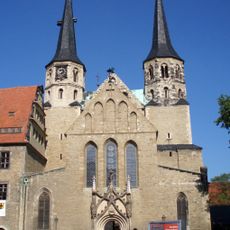
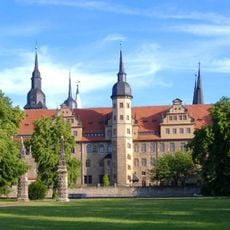
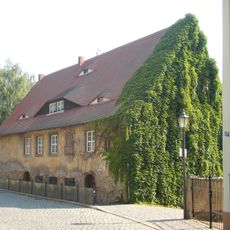
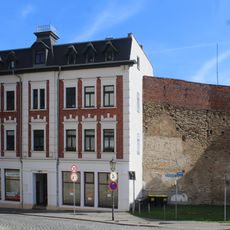
Neumarktkirche St. Thomae, Romanesque church in Merseburg, Germany.
The Neumarktkirche St. Thomae is a Romanesque church built of regular rubble stone masonry, originally a flat-roofed basilica with two towers at the west ends of the aisles. After the 1825/26 restoration only the north aisle, north tower and north side apse remain; the ground was raised 1.5 to 2 metres because of the rising groundwater, so the building appears sunken. The main apse cornice carries a ball frieze, and the west gable has a round-arched window flanked by two quatrefoil windows.
The building was constructed in two phases between 1173 and 1188, with construction moving from east to west. Emperor Frederick I Barbarossa documented the church in 1188, confirming its importance at that time.
The church is named after Thomas Becket, canonised in 1173, the year its construction began. Today a relief of the saint by Gabriele Messerschmidt hangs inside, alongside a Crucifixus in the triumphal arch and a seven-part figure group, Terra Ottonum, by Dieter M. Weidenbach. Since 1993 it has again served for services and is a station on the ecumenical pilgrim route to Santiago de Compostela, with overnight accommodation.
You can visit the church from May through October on Saturdays between 14:00 and 17:00. If you want to learn more about the history, you can contact Merseburg Tourist Information for additional guided tours.
The knot column stands on the main portal of the transept, not a stairway; it was moved there from the north aisle during the 1821 restoration. Its four round bars are twisted into a knot, a motif medieval builders used as a magical defence against demonic forces.
The community of curious travelers
AroundUs brings together thousands of curated places, local tips, and hidden gems, enriched daily by 92,660 contributors worldwide.