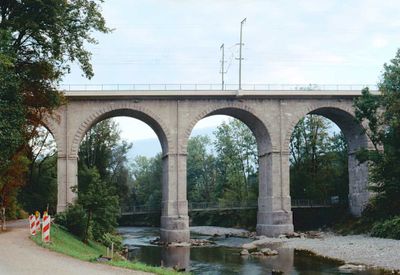
Traunstein arch railway bridge, Railway viaduct in Traunstein, Germany
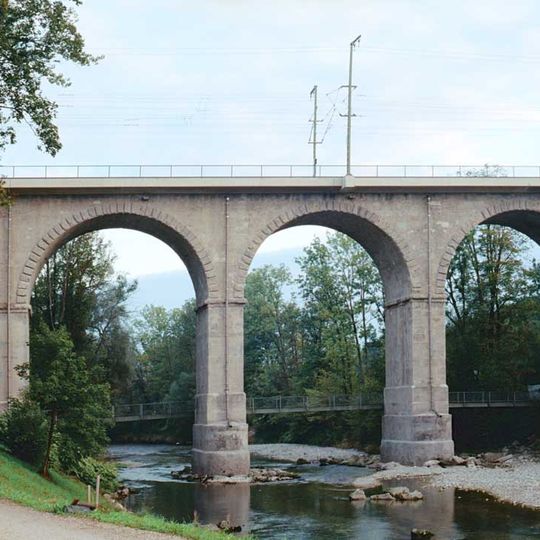
The Traunstein arch railway bridge is a viaduct that crosses the Traun River with five semicircular arches supported by four massive stone pillars. The structure spans about 105 meters and rises approximately 25 meters above the water, carrying two railway tracks on its 8-meter-wide deck.
Planning for the Rosenheim–Salzburg line began in 1854, and work at the Traunstein section started in January 1858. The viaduct opened on 12 August 1860, when King Maximilian II of Bavaria and Emperor Franz Joseph of Austria travelled the new Traunstein–Salzburg section by royal train. In 1945, Traunstein citizens prevented a Wehrmacht engineer unit from blowing up the bridge.
The bridge became a favourite subject for artists, and around 1900 it appeared in the foreground of many postcards of Traunstein. The viaduct is still regarded as one of the town's landmarks.
The viaduct is easily visible and accessible from the Traun riverbank, particularly from the walking paths that run along the water. Best viewing conditions occur during daylight hours when the details of the stone arch structure are clearly visible.
The bridge was first built on dry ground about 100 metres east of the Traun, then the riverbed was diverted so the Traun flowed beneath the finished viaduct. The two large approach embankments were heaped up only afterwards.
The community of curious travelers
AroundUs brings together thousands of curated places, local tips, and hidden gems, enriched daily by 94,218 contributors worldwide.