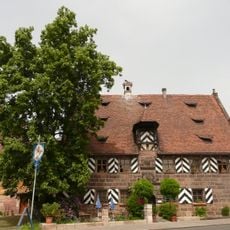
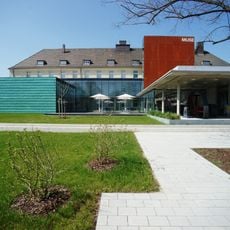
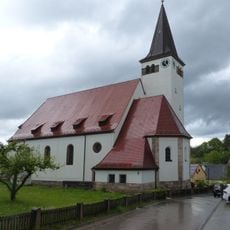
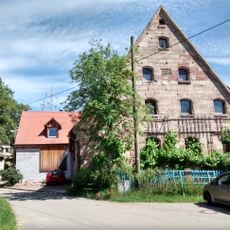
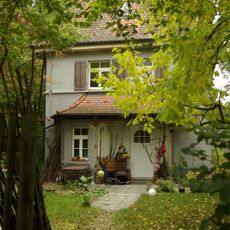
Former moated castle, Former moated castle in Wolkersdorf, Schwabach, Germany.
Schloss Wolkersdorf is a former moated castle occupying an almost square plot of about 28 by 26 metres. Its three-storey main building survives, while the surrounding ring wall is much reduced and only one of the original four square corner towers remains, the others having been demolished in the 19th century. A drawbridge on the south side crosses the now filled-in moat into the courtyard.
Schloss Wolkersdorf is first documented in 1297, when a local noble family of "Vokoltstorf" is mentioned; Nuremberg patricians later held the castle and estate. The Tucher family owned it in 1390, the Geuder in 1482 and the Landauer in 1512. It was burned in the Second Margrave War in 1552 and rebuilt by Hieronymus Murr, destroyed again in 1632 during the Thirty Years' War and rebuilt once more. The Fürer von Haimendorf held it from 1630 to 1843.
The name Wolkersdorf first appears in 1297 as "Vokoltstorf", referring to a local noble family; the castle itself was a moated seat held by Nuremberg patrician families. The Tucher owned it from 1390, the Geuder from 1482 and the Landauer from 1512, and these families repeatedly granted the city of Schwabach the right to open the castle in wartime.
The castle stands at the northwest edge of Wolkersdorf, a district of Schwabach. The moat is filled in today, so no water defenses are visible; the south side is reached by a drawbridge leading into the castle courtyard. The ring wall is much reduced and only one of the four corner towers remains.
The moat is now filled in, so no water is visible; only the south-side drawbridge still crosses it into the castle courtyard. Of the four original square corner towers, just one survives, the others having been demolished in the 19th century. The site is recorded as a Bodendenkmal (D-5-6632-0164) and a Baudenkmal (D-5-65-000-263).
The community of curious travelers
AroundUs brings together thousands of curated places, local tips, and hidden gems, enriched daily by 92,828 contributors worldwide.