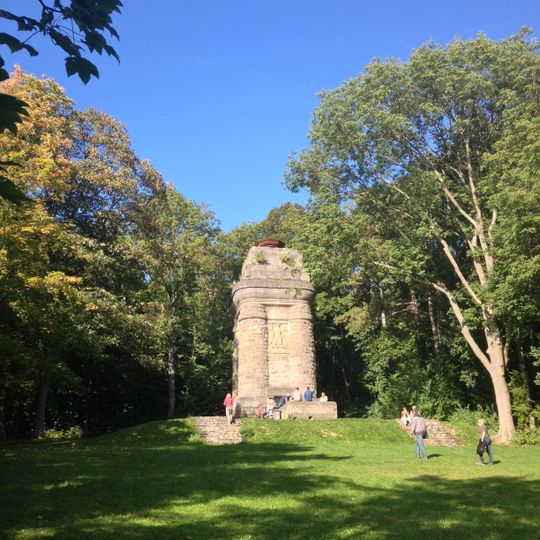
Bismarck Tower, Bismarck tower in Würzburg, Germany
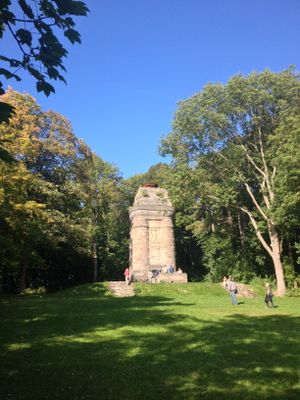
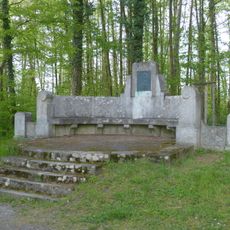
The Bismarck Tower in Würzburg is a 15-meter-high lookout tower with a lighting device, built in 1905 on the Steinberg above the vineyards. It follows Wilhelm Kreis's 'Götterdämmerung' design and is made of Franconian shell limestone from quarries in Randersacker, Eibelstadt and Sommerhausen. A fire bowl at the top could be lit on special occasions.
The idea of a fire column for Bismarck came from professor Oskar Schultze shortly after Bismarck's death; a student committee founded on 1 April 1899 raised 100 marks before dissolving. Donations funded the project, built in 1905 by Würzburg master builder J. E. Weber and architect Franz Ostberg using Franconian shell limestone from Randersacker, Eibelstadt and Sommerhausen. The foundation stone was laid on 1 April 1905, work took three months, and the tower was inaugurated on 2 July 1905, when Schultze spoke and the column was handed to mayor Philipp Michel.
The name 'Bismarcksäule' or 'Bismarck Fire Column' reflects its original role as a memorial to a political leader of that era. The location in Bismarckwäldchen, a wooded area near vineyards, shows how the site once served as a gathering place for patriotic events that connected the local community to broader national sentiments.
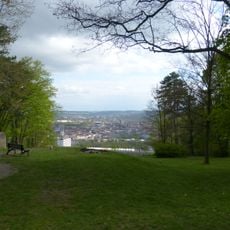
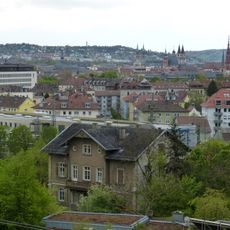
The tower stands on the Steinberg about 1,700 m north of Würzburg's centre, in the Bismarckswäldchen above the vineyards. It is reached on foot along paths through the wooded slope; no road leads directly to it. The 15 m structure is a lookout tower, so the reward for the climb is the view over the vineyards and the city.
The tower was designed as a fire column: a bowl at the top could be lit in the evening for events visible from afar. The idea came from university professor Oskar Schultze, who proposed the monument soon after Bismarck's death and later gave the inauguration speech on 2 July 1905.
The community of curious travelers
AroundUs brings together thousands of curated places, local tips, and hidden gems, enriched daily by 92,722 contributors worldwide.