Weinheim Museum, Municipal museum in Weinheim, Germany
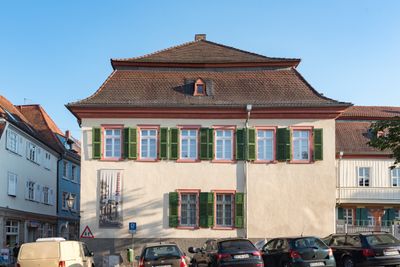
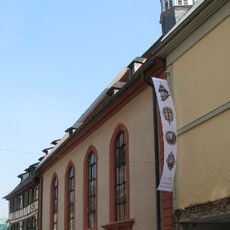
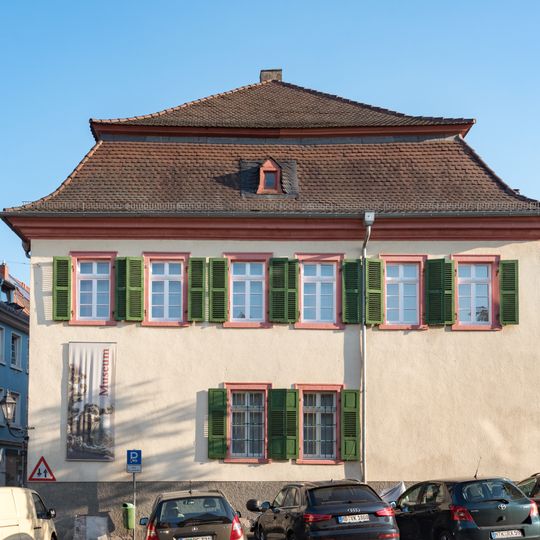
Weinheim Museum occupies the Deutschordenshaus, a Baroque building erected from May 1710 under Hoch- und Deutschmeister Franz Ludwig von Pfalz-Neuburg; the carpenter Peter Elias Berthold of Neckarsulm is named in surviving bills. The cream facade with its steep brown-tiled hipped roof, red dormer and six shuttered upper windows faces the old town, and a sandstone relief of Franz Ludwig's coat of arms, carved in 1711 by Georg Martin Bitterich of Mannheim, remains on the former entrance portal. The permanent exhibition fills four floors, about 1000 m².
The Weinheimer Altertumsverein, active from 1906 to 1938, systematically collected historical objects from the region; the collection was shown in three different buildings before moving to the Deutschordenshaus in 1939. The house itself was built from May 1710 as a baroque new building of the Teutonic Order's Kommende, to plans by master carpenter Peter Elias Berthold of Neckarsulm, at a cost of 10,000 gulden, with the topping-out held in November 1710. The museum opened here in 1948 as a Heimatmuseum and was renamed Museum der Stadt Weinheim in 1986.
The museum's name changed from Heimatmuseum to Museum der Stadt Weinheim in 1986. The building itself carries the history: a sandstone relief of the coat of arms of Franz Ludwig von Pfalz-Neuburg, carved in 1711 by Mannheim sculptor Georg Martin Bitterich, sits on the former entrance portal, and near the corner oriel at Amtsgasse/Hauptstraße a much older, weathered coat of arms of Walther von Cronberg, High Master from 1527, is set about two metres up the wall.
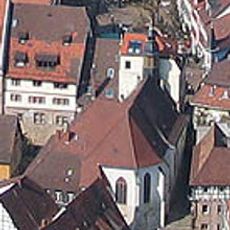
The museum occupies the baroque Deutschordenshaus between Amtsgasse and Schlossergasse in Weinheim's old town; the entrance portal carries a sandstone relief of the coat of arms of Franz Ludwig von Pfalz-Neuburg, carved in 1711 by Georg Martin Bitterich. The permanent exhibition fills four floors over roughly 1000 m², so allow time to work through all levels.
The oldest object is a mammoth skull found in 1967; its age of up to 42,000 years was only recognised in 2020. The building itself was erected from May 1710 for the Teutonic Order under Franz Ludwig von Pfalz-Neuburg, at a cost of 10,000 guilders, with Peter Elias Berthold of Neckarsulm as master builder.
The community of curious travelers
AroundUs brings together thousands of curated places, local tips, and hidden gems, enriched daily by 94,459 contributors worldwide.