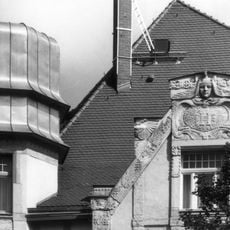
Villa Sack, Neo-baroque villa in Plagwitz, Germany
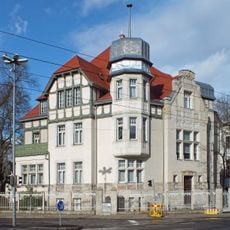
Villa Sack is a free-standing neo-baroque house set back from Karl-Heine-Straße 12, built on a footprint of about 36 by 20 metres. It has two storeys above a high basement, five window axes facing the street and four on the gable ends, a tuff-stone facade divided by flat pilasters, and a mansard hipped roof with a converted storey. A winter garden, an oriel and an L-shaped outbuilding with a hipped roof stand on the grounds.
Fritz Sack, co-owner of the Rudolph Sack agricultural machinery factory, had the house built in 1909 to designs by Schmidt & Johlige; his brother-in-law Arthur Johlige was a partner in the firm. In 1933 the University of Leipzig ran it as a students' "Kameradschaftshaus", and in 1939/40 two Gestapo departments moved in. It became Reich property on 1 January 1941, and its roof was destroyed in the Second World War.
After 1950, the building served as a public leisure facility tied to local working communities. It shows how a private residence was repurposed to serve collective needs across different historical periods.
The building underwent complete renovation from 1995 to 1997, including installation of an elevator serving all floors. This modernization improved accessibility throughout the mansion for contemporary use and visits.
Since 1 July 2026 the villa has housed three Criminal Senates of the Federal Court of Justice: the 5th moved in on 14 July 1997, the 6th was re-established here on 15 February 2020, and the 7th was added by the Federal Ministry of Justice. Visitors may notice the restored stucco ceilings and three small wall fountains with mosaics.
The community of curious travelers
AroundUs brings together thousands of curated places, local tips, and hidden gems, enriched daily by 94,512 contributors worldwide.