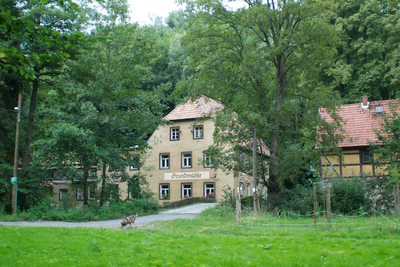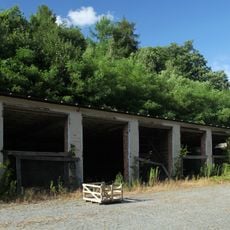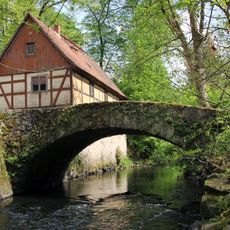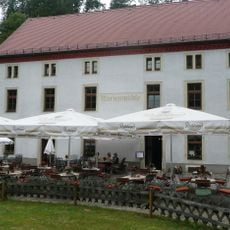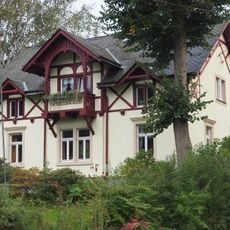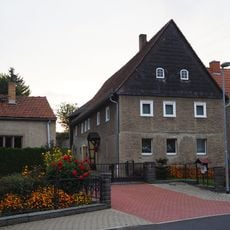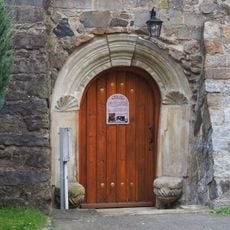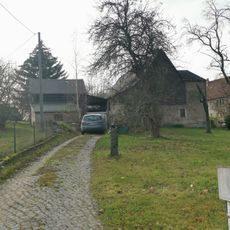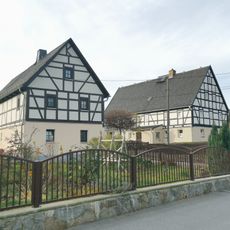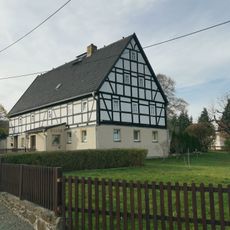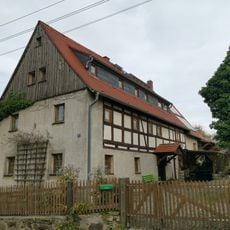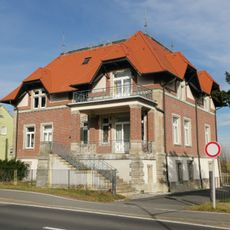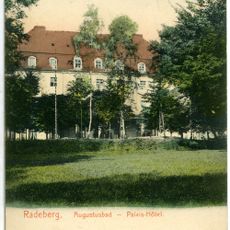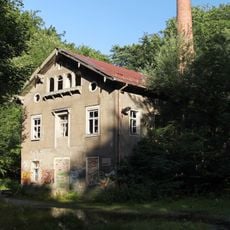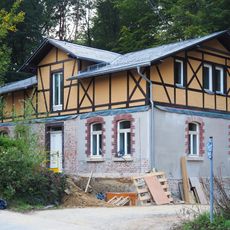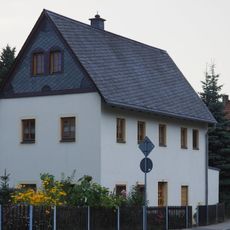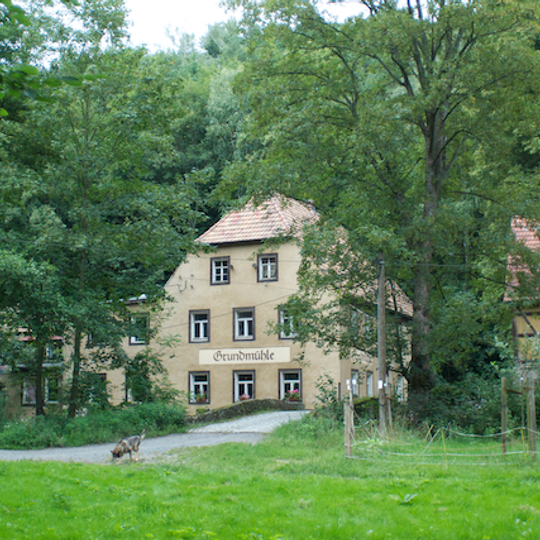
Grundmühle Liegau-Augustusbad, Mill building with rear addition, eastern and northwestern outbuildings, and barn of a mill property; mill building (former inn) inscribed in keystone 1826, eastern outbuilding upper story half-timbered (former bakery)
Grundmühle Liegau-Augustusbad is a watermill complex located along the Große Röder river, comprising several buildings including a bakery house where remnants of the original oven remain visible. The layout and structures reveal how grain milling and baking operations functioned together in a single site.
Karl Gottlieb Arnoldt established this mill complex in 1826 at the water's edge along the Röder river. As industrialization transformed agricultural production, the site shifted from grain milling to operating as a restaurant, giving it renewed purpose.
The mill demonstrates traditional German techniques for harnessing water power, practices that shaped rural communities for generations. The buildings and their 19th-century details reflect the craftsmanship of this milling tradition.
The site is reachable via the circular hiking trail around Radeberg and the Lusatian Snake long-distance path, both of which pass through the region. Visitors should wear sturdy footwear since these walking routes are sometimes unpaved.
Between 1916 and 1919, naturalist Georg Naumann spent formative years at the complex learning the practical trades of milling and baking. His time there linked practical craft knowledge with his later scientific work, reflecting how rural industrial sites trained skilled workers across different fields.
The community of curious travelers
AroundUs brings together thousands of curated places, local tips, and hidden gems, enriched daily by 92,654 contributors worldwide.