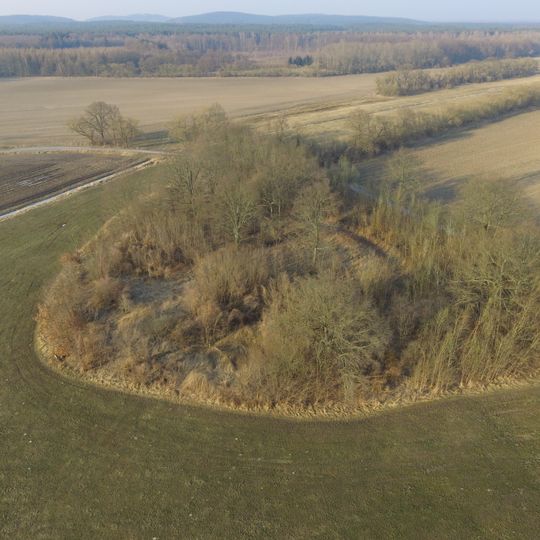
Burgwall Hohennauen-Witzke, Slavic hillfort site in Brandenburg, Germany
Burgwall Hohennauen-Witzke is a nearly circular Slavic ringwork in a drained lowland about 1.7 km east of Elslaake and 1.6 km north of Witzke. Its inner area, 42 to 45 m across, rises 1 to 1.5 m above the surroundings; the surrounding rampart is 8 to 11 m wide and about half a metre high, fronted by a moat some 7 m wide and half a metre deep. A gap in the northwest is read as the former gate.
This defensive fortress was built by Slavic settlers during the 7th or 8th century and protected their settlement. It was eventually abandoned sometime in the 8th or 9th century and gradually fell into disuse.
The ceramics and artifacts found here show how early Slavic people lived and worked in this region long ago. These everyday objects give visitors a sense of daily life in the settlement that once occupied this place.
The site lies in a drained lowland about 1.7 km east of Elslaake and 1.6 km north of Witzke, in the Elslaake district; there are no marked paths or facilities, so approach on foot across the open ground. The rampart stands only about half a metre high and the moat about half a metre deep, so the earthworks are easy to overlook. Sturdy footwear helps, as the former fen soil stays damp.
The site is listed as monument number 50246, recorded as an Iron Age settlement, a Slavic medieval rampart and a Slavic medieval settlement. The rampart's interior measures 42 to 45 metres across, the surrounding wall is 8 to 11 metres wide, and the moat about 7 metres wide lies roughly half a metre below the surrounding ground.
The community of curious travelers
AroundUs brings together thousands of curated places, local tips, and hidden gems, enriched daily by 92,757 contributors worldwide.