Schloss Fremersdorf, Renaissance château in Fremersdorf, Germany
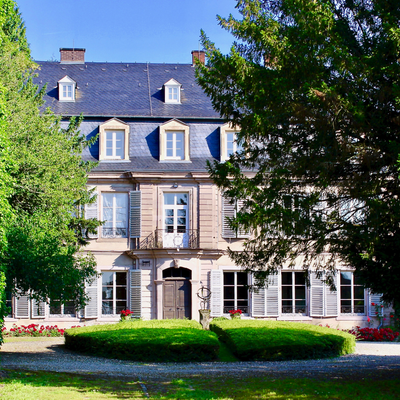
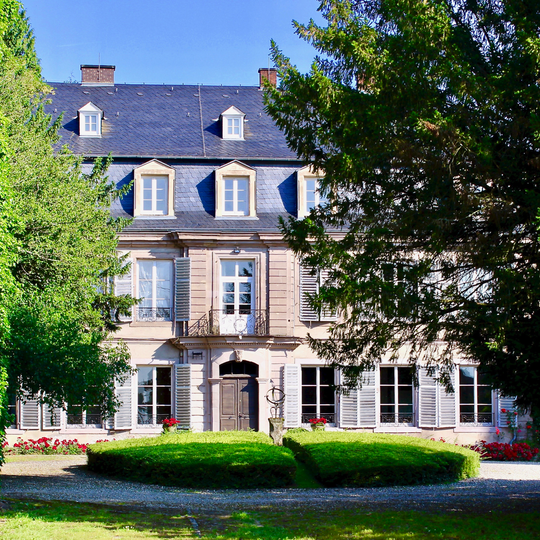
Schloss Fremersdorf is a Renaissance castle in Fremersdorf, a village in the Saar region of Germany that is now part of the municipality of Rehlingen-Siersburg. The main building has two floors with seven window bays and a Baroque mansard roof, while three rectangular towers with tent roofs mark the rear section of the structure.
The estate was given to the Abbey of St. Vanne in Verdun in 1040 by Oda, wife of Duke Gottfried of Lorraine; the abbey sold it in 1199 to the Benedictine abbey of St. Matthias in Trier. A moated castle may have risen around 1240 between the Geisbach and the Saar. The medieval castle was demolished by about 1620, when Wilhelm Marzloff von Braubach built a Renaissance palace; the present main building dates from around 1797, and the property passed to Jean Christophe de Galhau in 1737.
The estate's name comes from the Fremersdorf lords, first recorded in 1158 as Hermann von Frummerstorf; the male line died out in 1342 with Jakob von Fremersdorf. Above the entrance portal, framed by pilasters, hangs the coat of arms of the de Galhau family, who bought the property in 1737 and came from Namur in Wallonia. Inside, oil paintings of the von Boch family hang on the walls.
The castle is privately owned by the von Boch family and is not open to visitors. The exterior can be seen from the road without entering the grounds, which gives a clear view of the building's overall form.
The A8 motorway, which runs along the Saar River, was built through part of the original castle park, permanently reducing its size. What remains of the grounds today is only a fragment of what once surrounded the building.
The community of curious travelers
AroundUs brings together thousands of curated places, local tips, and hidden gems, enriched daily by 92,722 contributors worldwide.