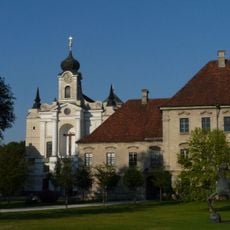
Wallfahrtskirche St. Maria Himmelfahrt, Catholic pilgrimage church in Burghausen, Bavaria, Germany
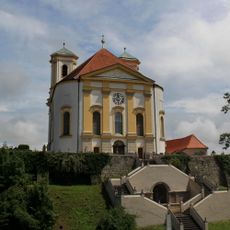
Maria Königin des Rosenkranzes is a Baroque central-plan church on Marienberg hill above Burghausen, built 1760–1764 by Trostberg master mason Franz Alois Mayr. Its Greek-cross plan measures 24.65 m long, 23.20 m wide and 21.28 m high, with two concave towers capped by flat copper tents. The west approach has five flights of ten steps, echoing the rosary.
A chapel on Marienberg was first documented in 1145/1146, when a Cistercian monastery moved from Schützing to Raitenhaslach; the parish passed to the monastery in a 1203 deed of Archbishop Eberhard II of Salzburg. A church consecrated on 7 August 1244 was enlarged in 1398, and pilgrimage grew after Landshut Dominicans founded a rosary confraternity in 1627. Abbot Emanuel II laid the foundation stone of the present church on 27 September 1760; Trostberg master mason Franz Alois Mayr built it, and Archbishop Sigismund von Schrattenbach consecrated it on 1 May 1765. After secularisation it was slated for demolition in 1806, but Crown Prince Ludwig's 1812 visit secured its survival; it reopened for services on 15 January 1815 as a filial church.
The ceiling frescoes are by Johann Martin Heigl, a pupil of Johann Baptist Zimmermann, and all are devoted to the rosary. The dome painting joins four scenes: the church as a ship, a lighthouse, a garden and the gate of heaven. The side frescoes show the joyful mysteries of the rosary.
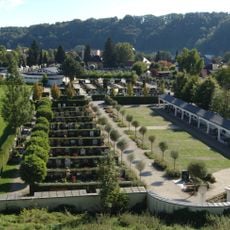
The west approach is a staircase of five flights of ten steps each, laid out to mirror the decades of the rosary; the stair cheeks carry inverted Romanesque pilasters topped with spheres. The church stands on the Marienberg above Burghausen and is surrounded by a cemetery. A wooden model of the church from around 1759/1760, showing the planned tall tower crowns, is kept in the Burghausen city museum.
In the Burghausen town museum a wooden model of the church from around 1759/1760 survives, about 81 cm tall. It shows the planned tall tower tops and, once the west facade is removed, the whole interior, with the high altar, oratories and pulpits in three dimensions and the ceiling frescoes visible through a mirror.
The community of curious travelers
AroundUs brings together thousands of curated places, local tips, and hidden gems, enriched daily by 92,760 contributors worldwide.