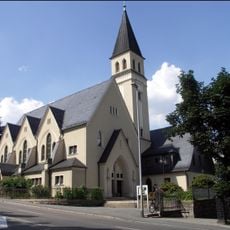
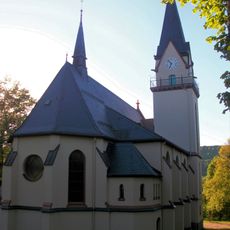
Kulturhaus Aue, Concert hall and cultural center in Aue-Bad Schlema, Germany.
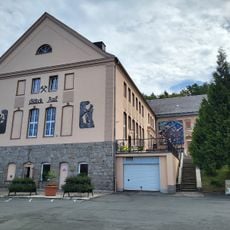
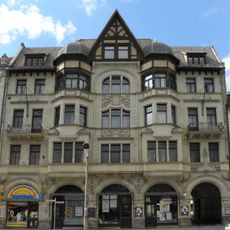
Kulturhaus Aue is a cultural and performance building at Goethestraße 2, on the western edge of the Aue Stadtgarten, connected to the town hall of Aue-Bad Schlema. Built 1953–1958 to a design by architect Heinz Voigtmann, it has a north facade sgraffito, 3.47 m wide and 6.15 m high, showing the house's dance ensemble, workers and miners protected by a soldier, based on a design by Heinz Lanzendorf.
The building was constructed between 1953 and 1958 by SDAG Wismut, the state uranium mining company, to serve as a cultural center for the mining region. Its development took place during the height of uranium extraction activities in the area.
The house's name comes from Ernst Thälmann, and its 1958 opening was attended by members of the GDR government. Since 1958 it has hosted the second workers' theatre of the GDR, founded with amateur actors after the first such group at the Warnowwerft. The Erzgebirgsensemble Aue, chosen to be led by Steffen Kindt, continues Erzgebirge song and music traditions.
The main entrance is at Goethestraße 2 on the west edge of the Stadtgarten, on rising ground; the south and west wings are reached through a secondary entrance on Lessingstraße. The building is physically joined to the Aue-Bad Schlema town hall on the neighbouring plot, so the two read as one architectural complex. The house was rebuilt for barrier-free access between 1992 and 2013, with a new terrace facing the park.
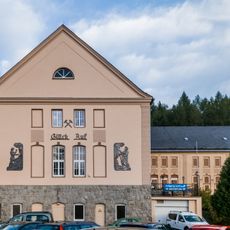
The building's north facade carries a 3.47 m wide and 6.15 m high sgraffito made during plastering, based on a design by the Werdau painter and graphic artist Heinz Lanzendorf. It shows the house's dance ensemble, local workers and miners, all guarded by a soldier.
The community of curious travelers
AroundUs brings together thousands of curated places, local tips, and hidden gems, enriched daily by 93,810 contributors worldwide.