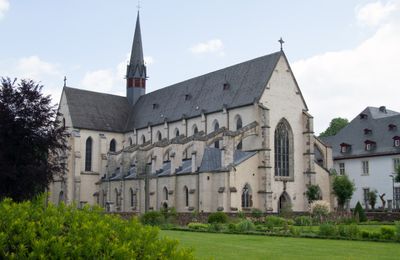
Monastery church Marienstatt, Medieval monastery church in Streithausen, Germany.
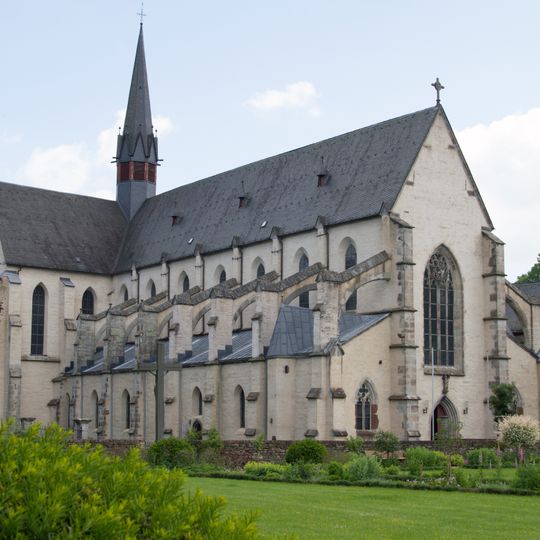
Monastery church Marienstatt is a Gothic religious building in Streithausen with a central nave, side aisles, and pointed arches supporting ribbed vaults overhead. The interior space feels airy and proportionate due to the careful balance of these architectural components.
Construction began shortly after the monks moved into the Nister valley in 1222, at the latest by 1245, and the church was consecrated in 1324 while still unfinished by Archbishop Heinrich von Virneburg of Cologne. It ranks with the Elisabethkirche in Marburg, begun in 1235, among the earliest Gothic churches east of the Rhine. The building was only completed around 1420, as the vault springers and keystone coats of arms of the west bays show. The monastery was dissolved in 1802 and the church became a parish church in 1831.
The church is dedicated to Our Lady, the Marian devotion central to the Cistercian order. Pope Pius XI raised it to the rank of Basilica minor on 27 July 1927, on the 700th anniversary of its consecration. It remains a pilgrimage church visited for the Marian shrine.
The church stands in the Nister valley at about 235 m, roughly 65 km east of Bonn. The interior is 62 m long, the nave 20 m and the central aisle 9 m wide, so allow time to walk its length. The choir is ringed by a chapel ambulatory between stepped buttresses; the crossing carries an octagonal roof turret with a tall spire, rebuilt in its present proportions in 1931.
The choir stalls, carved around 1290, are among the oldest still in use in Germany: 58 seats in two rows, moved eastward over the centuries until they now stand in the transept. The abbot's stall shows a pelican feeding its young with its own blood.
The community of curious travelers
AroundUs brings together thousands of curated places, local tips, and hidden gems, enriched daily by 94,534 contributors worldwide.