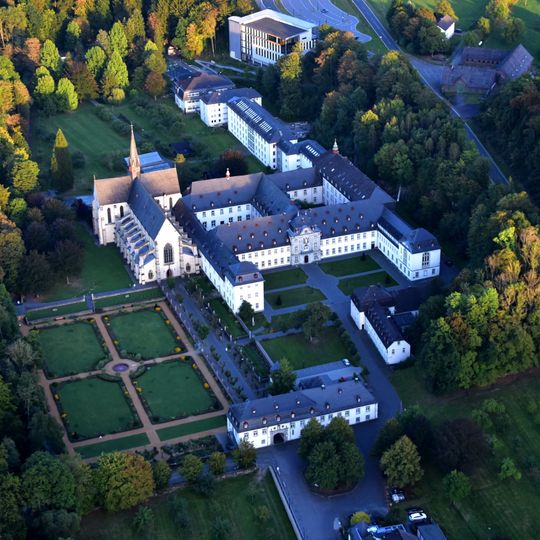
Marienstatt Abbey, Cistercian monastery in Streithausen, Rhineland-Palatinate, Germany.
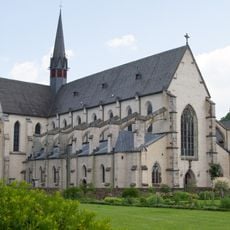
Marienstatt Abbey is a Cistercian monastery in the Nister valley at Streithausen, near Hachenburg. Its early-Gothic basilica has a tall slender spire and a high gabled facade with pointed windows; long multi-storey wings with rows of rectangular windows and roof dormers enclose courtyards. A lower white building with a central arched gateway stands beside a garden laid out in rectangular plots.
The monastery was founded in 1212 and relocated to its current site in 1222 when monks realized the original location was unsuitable. Settlement in the Nister valley shaped a continuous development as a spiritual and economic center for centuries.
The abbey's name, Marienstatt (Latin: locus Sanctae Mariae, "Place of Mary"), comes from a vision experienced by Abbot Hermann, who saw a hawthorn bush flowering in winter. A cutting of that bush stands between the monastery buildings and the basilica avenue, near the statue of Joseph, and a flowering hawthorn branch appears in the abbey's coat of arms. Since 1485 the main pilgrimage day has been the octave of Corpus Christi.
The monastery welcomes visitors with guided tours and offers lodging for those seeking time for reflection. A well-stocked library with historical holdings can be explored during your visit.
The present organ was built between 1969 and 1970 by Franz Rieger; it replaced an 1854 instrument by Daniel Raßmann with 16 stops, which was demolished in 1941 during a restoration of the church. A choir organ with 45 stops, used from 1912, was moved to the parish hall and later sold to a Cologne parish in 1964.
The community of curious travelers
AroundUs brings together thousands of curated places, local tips, and hidden gems, enriched daily by 94,501 contributors worldwide.