St. Wilhadi Church, Medieval church in Ulsnis, Germany.
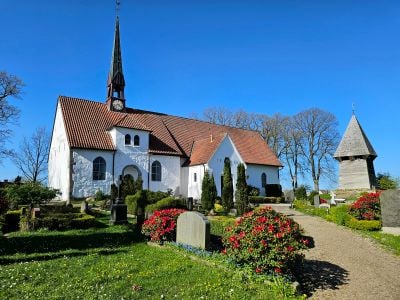
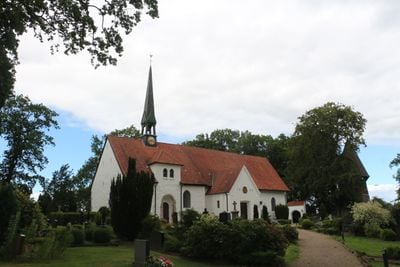
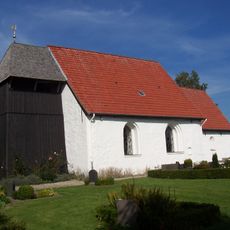
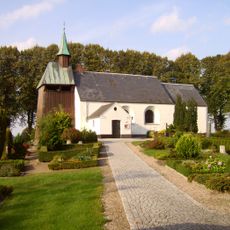
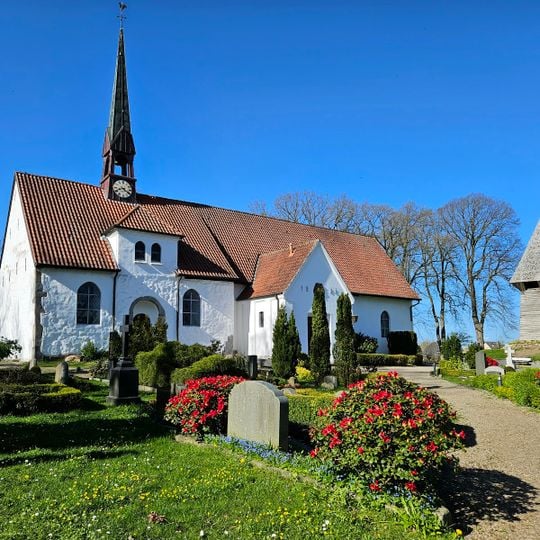
St. Wilhadi Church is a Romanesque fieldstone church on a rise above the Schlei, built in the mid-12th century with local boulders and Rhenish tuff. Its white-plastered walls carry a steep red-tiled roof, a dark pointed spire with a clock, and a low arched south doorway. A western extension, probably pre-1200, has fieldstone walls twice as thick as the original nave.
The building was constructed during the 12th century and later dedicated to missionary Willehad, replacing an earlier dedication to Mary. This change shows how religious focus shifted in the region over time.
The church is dedicated to missionary Willehad and shapes the landscape with its solid stone presence. Inside, it shows how people expressed their faith over centuries through crafted objects and the sound of a grand organ.
The church stands on a rise by the Schlei, reached by two avenues from the east and southwest, each ending at a white-plastered brick gate to the cemetery; the gates date from 1716 and 1772. The south portal is still in use, while the north portal is walled up. The bell tower stands outside the cemetery on a Bronze Age mound, so the bells are seen before the church itself.
The Bronze Age burial mound is not under the church but east of it, outside the cemetery wall, and carries the wooden bell frame of 1759 with three bells cast in 1869, 1959 and 1996. The two carved stones are not in the eastern extension: the corner block with the dancer and the embracing pair sits at the northeast corner, and the pair stone is now set in the south wall.
The community of curious travelers
AroundUs brings together thousands of curated places, local tips, and hidden gems, enriched daily by 94,573 contributors worldwide.