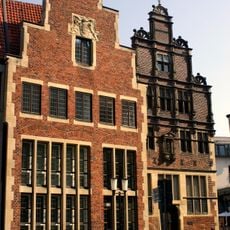
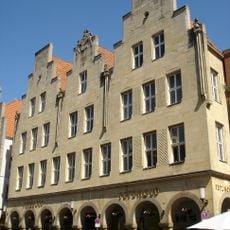
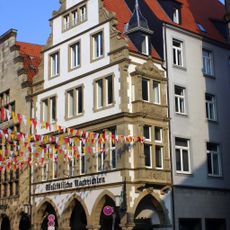
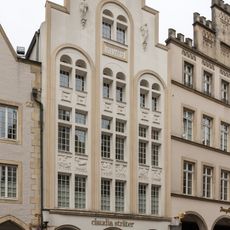
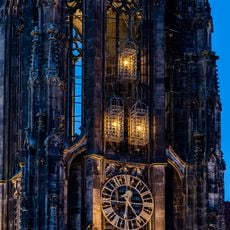
Stadtweinhaus, Renaissance building in Münster, Germany.
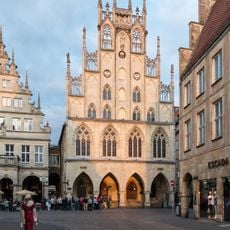
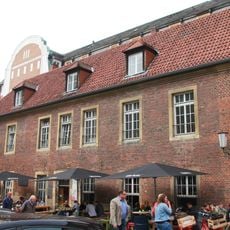
The Stadtweinhaus is a Renaissance building in Münster with stone columns along its facade, standing directly beside the Historical Town Hall at Prinzipalmarkt. The two structures form a connected architectural complex, with spaces linked through a passage from the wine building's hall to the Town Hall's festival room.
The building was constructed in 1615 under the design of architect Johann von Bocholt and originally functioned as a wine storage facility for Münster's city council. After destruction in World War II, it was reconstructed to restore its original Renaissance form.
The name recalls the building's origin as the city council's wine store, and a wine tavern on the ground floor still refers to that role; in summer wine tastings extend outside into the Marktstraße. The large hall behind the balcony hosts council sessions and festivities, and the balcony is used by the mayor to greet the annual Rosenmontagszug carnival parade.
The ground floor holds a wine tavern recalling the building's former role as the city's wine store; tastings in summer move outside and can reach into the Marktstraße of the Prinzipalmarkt. The large hall behind the balcony is reached from the Rathaus festival room through a passage on the first floor, so the two halls can be combined for large events. The balcony is used for greetings such as the Rosenmontagszug.
During reconstruction after World War II, workers uncovered approximately 2000 silver coins and jewelry pieces hidden in the walls, dating from before 1348. This discovery suggests someone had concealed their valuables there, possibly to protect them during uncertain times.
The community of curious travelers
AroundUs brings together thousands of curated places, local tips, and hidden gems, enriched daily by 94,410 contributors worldwide.