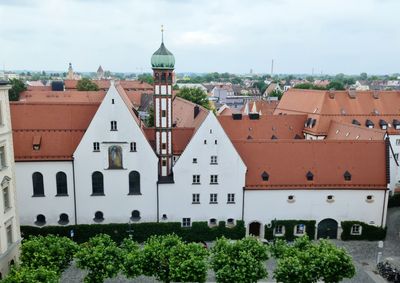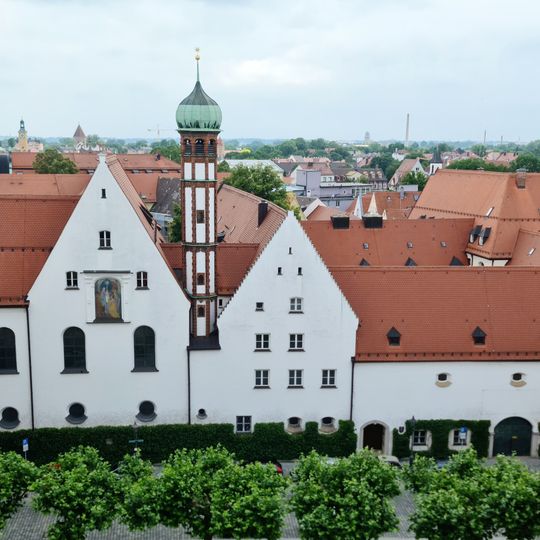
Kloster Sterngasse 3 1/2; Sterngasse 5 in Augsburg, Franciscan monastery in Augsburg, Germany.
Kloster Sterngasse is a Franciscan monastery in Augsburg that comprises multiple buildings from different periods. The complex displays a mixture of medieval and Renaissance architectural styles across its structures, reflecting the various construction phases that shaped the ensemble.
In 1567 abbess Anna Krölin commissioned Johannes Holl, father of Elias Holl, to build the present three-aisled church, consecrated in 1576 to Saints Anne and Elizabeth. A chapel and nuns' choir were added in 1685, and the interior was refitted in Baroque style in 1730 with frescoes by Johann Georg Bergmüller. The monastery was dissolved in the secularisation of 1802 and the church used as a slaughterhouse; it was reconsecrated in 1828 and burned out in the bombing night of 25–26 February 1944, then largely reconstructed.
The church is dedicated to Saint Anne and Saint Elizabeth, consecrated in 1576 by Auxiliary Bishop Michael Dornvogel. The high altarpiece of around 1730 is by Johann Georg Bergmüller, who also created the ceiling frescoes, reinterpreted after 1944 by Karl Manninger. A late-Gothic crucifix from around 1575 and a Baroque pulpit by Ehrgott Bernhard Bendel remain in the interior.
The monastery is centrally located in Augsburg and can be reached on foot from the city center. Visitors should check ahead about access, as the buildings function as an active religious community and are not always open to the public.
The slender tower between the two gables, painted with red and white vertical stripes and capped by a green onion dome, is considered the first onion dome built in southern Germany. It was erected during the church construction from 1567 to 1576, and its design may go back to Elias Holl, son of the master builder Johannes Holl.
The community of curious travelers
AroundUs brings together thousands of curated places, local tips, and hidden gems, enriched daily by 94,227 contributors worldwide.