Alte Kapelle, Cultural heritage church in Landstuhl, Germany.
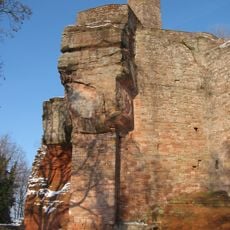
Alte Kapelle is the surviving choir of the medieval St. Andreas Church in Landstuhl, measuring about 6.50 by 5.50 metres with two bays and a three-sided apse. Six Gothic buttresses remain outside, and the interior, closed off by an iron grille, is covered by Gothic rib vaults with 15th-century wall paintings.
The surviving structure is the choir of the medieval St. Andreas Church, probably built in the 14th century on the site of an 8th-century church dedicated to St. Jodok. After the nave was demolished in 1805, the choir was converted into a chapel and consecrated in 1829 as the Heilig-Kreuz-Kapelle. Its stones were used to build the nearby Kaiserstraße.
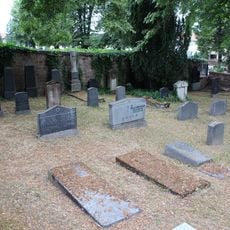
The name Heilig-Kreuz-Kapelle was given at the 1829 consecration and had earlier belonged to a chapel at the Ramsteiner Straße junction, demolished in 1811. The interior is separated from the entrance by a wrought-iron grille, so the painted choir is visible but not entered. South of the chapel survive 18th- and 19th-century gravestones of Landstuhl citizens.
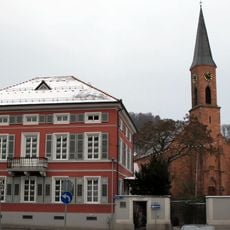
The chapel stands at the foot of the Kirchberg, where Luitpoldstraße branches off Ludwigstraße, next to the Protestant town church and the Catholic Heilig-Geist parish church. The interior is cut off from the entrance area by a wrought-iron grille and is not open to the public, so the building is seen from outside. South of the chapel, gravestones of Landstuhl citizens from the 18th and 19th centuries remain; a war cemetery laid out in the Second World War lies to the west.
The name Alte Kapelle simply means "old chapel" in German, a label that implicitly signals there were newer places of worship built in the town over time. This plain name is itself a small piece of evidence about how the town's religious landscape changed across the centuries.
The community of curious travelers
AroundUs brings together thousands of curated places, local tips, and hidden gems, enriched daily by 94,514 contributors worldwide.