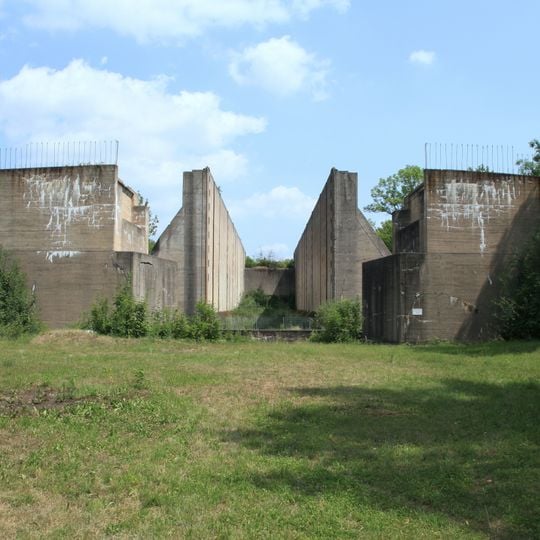
Schleusentreppe Wüsteneutzsch, Lock ruins in Leuna, Germany
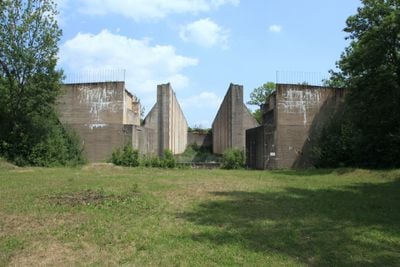
The Schleusentreppe Wüsteneutzsch is a planned pair of shaft locks on the never-finished Elster-Saale Canal at kilometre 1.81, near Wüsteneutzsch in Kreypau, a district of Leuna. Only the upper chamber was begun, founded in rock and built as a concrete gravity wall; its weathered remains stand as three separate wall sections with recessed vertical channels on the inner faces of the outer blocks.
Construction of this lock for the Elster-Saale Canal system began in 1933 but was halted in 1943 during World War II. The upper chamber remained incomplete and the project was never finished.
The name Wüsteneutzsch combines the village name with the lock staircase planned for the Elster-Saale-Kanal, called Saale-Leipzig-Kanal since 1999. The design reflects pre-war inland shipping: tugboats were to be swapped in the harbours, and in the 360-metre middle basin barges were to be pulled by a cable-haulage system, so self-propelled vessels were still rare.
The ruin lies at kilometre 1.81 of the former Elster-Saale-Kanal, now the Saale-Leipzig-Kanal, near Wüsteneutzsch in the Leuna municipality of Saxony-Anhalt. Only the upper of the two planned chambers was built; the concrete walls stand open to the weather, with grass and vegetation at their base. Approach on foot and wear sturdy shoes, as the ground around the three wall sections is unpaved.
Only the upper of the two planned chambers was ever built; the lower one never got beyond planning. The finished chamber was founded in rock and built as a concrete gravity wall, and the 360-metre stretch between the chambers was meant as a passing and turning basin for tugs and their towed barges.
The community of curious travelers
AroundUs brings together thousands of curated places, local tips, and hidden gems, enriched daily by 92,868 contributors worldwide.