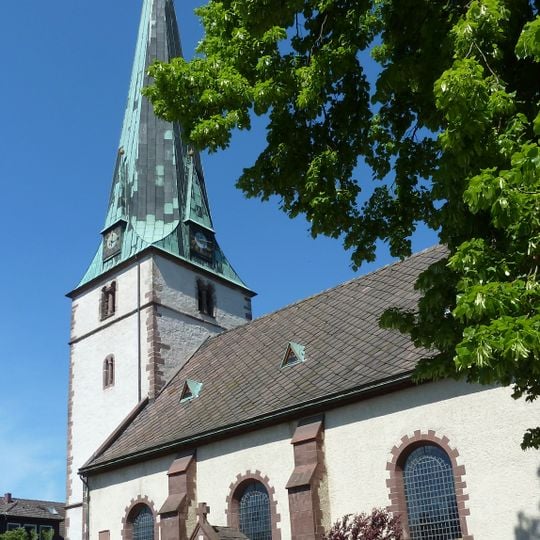
Lutherkirche, Protestant church building in Holzminden, Germany.
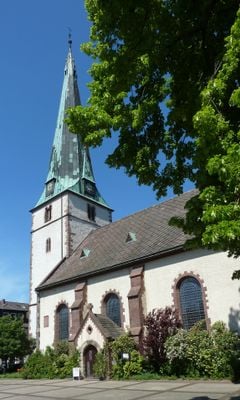
Lutherkirche is a Protestant church in Holzminden with white walls and reddish-brown stone trim. Its square west tower carries a steep, green-clad spire with a clock face; the nave to the east has a dark brown roof with three small dormer vents and two round-arched, gridded windows in stone frames. Inside, two octagonal pillars support cross-ribbed vaults.
First documented in 1231 as the parish church of St. Mary, it was a vaulted hall church with a west tower whose arrow slits and embedded stone balls recall its defensive role. A 1506 inscription tablet at the tower's southwest corner records late-medieval repairs. After the Reformation was introduced in Holzminden in 1568, the church was rebuilt from 1577 into a two-aisled hall with two octagonal piers, and the tower helm was added in 1595. A fire in 1640 destroyed the helm, rebuilt in 1659; a storm wrecked it again in 1898, prompting a restoration completed in 1900 that added a new choir, sacristy and baptistery.
Originally dedicated to St. Mary, the church has been called Lutherkirche only in modern times; the parish kept its name when it merged with St. Michaelis on 1 January 2021. From 1655 to 1837 the preacher here also held the office of general superintendent of the Brunswick Weser district and the title of abbot of Amelungsborn. A 1506 inscription panel on the southwest corner of the tower recalls late-medieval repairs.
The church stands in central Holzminden, its west tower facing the street with the main body and apse extending behind. The organ, built by Rudolf Janke between 1968 and 1970, sits north-side above a side entrance. Look for the 1506 inscription plaque at the tower's southwest corner and the embedded stone balls and arrow slits recalling the tower's defensive past.
The tower's lower section still shows splayed loopholes and stone balls walled into the masonry, traces of its original defensive role. A dated inscription panel from 1506 at the southwest corner records late-medieval repair work. The green-clad spire visible today is a replacement: an 1898 storm destroyed its predecessor, and the rebuilding led to the church's thorough restoration, completed in 1900.
The community of curious travelers
AroundUs brings together thousands of curated places, local tips, and hidden gems, enriched daily by 93,971 contributors worldwide.