Röttekensches Palais, Architectural heritage monument in Rheda-Wiedenbrück, Germany.
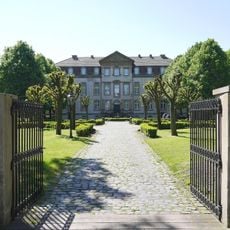
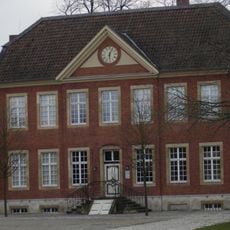
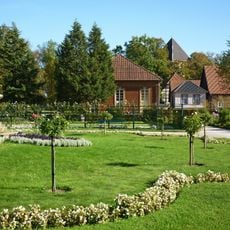
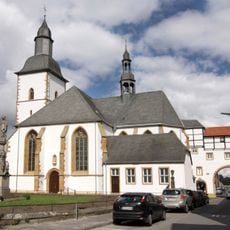
The Röttekensches Palais is a seven-axis neoclassical villa built in 1829/1830 in Rheda, opposite St. Clemens church. The plastered building has a shallow hipped roof, 13 rooms, and a sandstone-framed double front door with a fanlight, reached by an outdoor staircase. The Pixeler Straße side has one storey with six windows; the Röttekenstraße side has two storeys, a basement entrance, and a small square flat-roofed annex.
The palace was built during a period when affluent families in Westphalia expressed their power through impressive architecture. It represents the architectural developments that became characteristic of the region from the 19th century onward.
The building displays design choices typical of Westphalian homes from its era, showing how affluent families expressed their status through architectural style. You can observe regional craftsmanship traditions reflected in the facade details and decorative elements.
The palais is a private residence divided into two apartments since its 2019 renovation, so the building itself is not open to visitors. The enclosed 3,800-square-metre grounds, with the rose garden facing Pixeler Straße, can be seen from the public street; the former coach house now holds garages and parking spaces.
The palace's name honours Clemens August Rötteken, the princely chamber councillor who had it built in 1829/1830. As an influential administrative jurist in Berlin during the Prussian era, he helped ensure that the Cologne-Mindener railway ran through Rheda, which brought meat and furniture firms to the town. The estate has belonged to the House of Bentheim-Tecklenburg since July 1872.
The community of curious travelers
AroundUs brings together thousands of curated places, local tips, and hidden gems, enriched daily by 93,665 contributors worldwide.