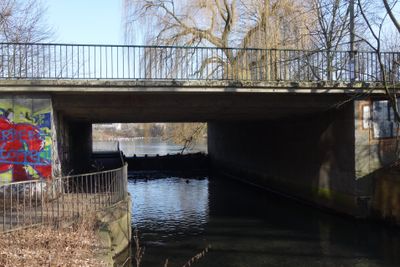
Mühlenstraßenbrücke, Road bridge in Wandsbek district, Hamburg, Germany
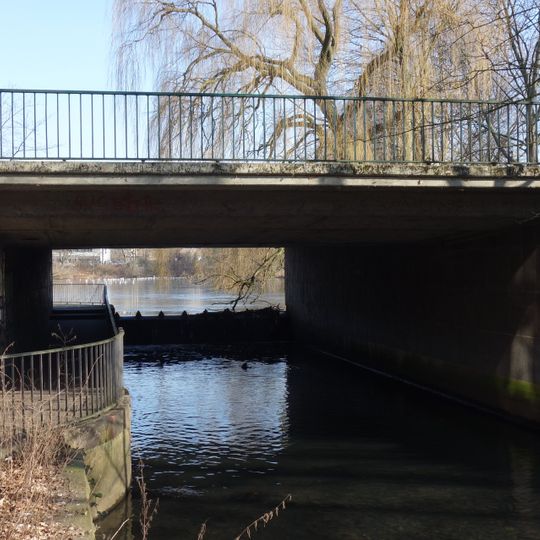
The Mühlenstraßenbrücke is a 20-metre-long, 14-metre-wide frame bridge carrying the four-lane Mühlenstraße over the Wandse in Wandsbek, just west of the Wandsbeker Mühlenteich. Its clear span is eight metres. Beneath the deck sit a weir regulating the pond's water level and an underpass linking the Wandse riverside path to the Wandsbeker Mühlenteichpark.
The current bridge was built in 1960, replacing an older, smaller crossing; it carries the four-lane Mühlenstraße over the Wandse and bears the structure number 2426141. Its name recalls a water mill, later a steam mill, that stood here until 1906. In 2021 work began on a fish ladder, a reinforced-concrete trough costing 1.8 million euros, built to meet the EU Water Framework Directive.
The name of street and bridge recalls the water mill, later a steam mill, that stood here until 1906. Since early 2026 Hamburg's oldest boundary stone, the Rantzaustein of 1573, set by Wandsbek's lord Heinrich Rantzau, stands beside the bridge; it marks a border once disputed with Barmbek landowners after the Wandse was dammed for the mill.
The bridge is accessible to pedestrians and cyclists crossing the Wandse in this area. Crossing is easiest outside peak traffic hours when vehicle congestion is lower.
Beside the bridge stands the Rantzaustein, Hamburg's oldest boundary stone, dated 1573 and set by Wandsbek landowner Heinrich Rantzau. It marks a border settled after disputes over damming the Wandse for the watermill; the stone, number 10, was moved several times during roadworks and last lay in a pub garden at Mühlenstraße/Eilbecker Weg before being placed here in early 2026.
The community of curious travelers
AroundUs brings together thousands of curated places, local tips, and hidden gems, enriched daily by 93,332 contributors worldwide.