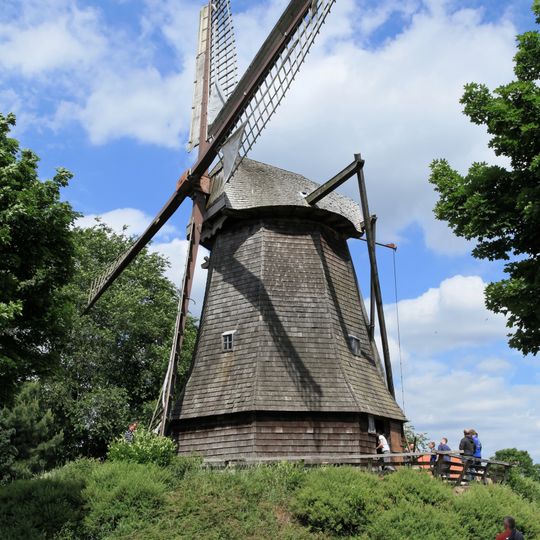
Windmühle Wippingen, Historical windmill in Wippingen, Germany.
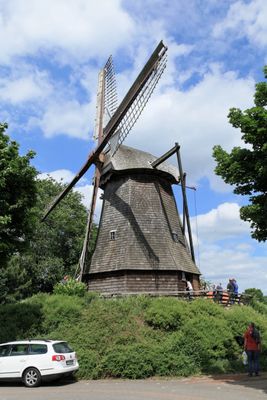
Windmühle Wippingen is a Durchfahrtsholländer, a Dutch-type earth mill built into a wall so that carts can drive through the centre; a flap in the middle of the wall lets a sack hoist load and unload grain. The mill has two grinding passes, a peldegang and a sack hoist, and its sails can be covered with cloth. A Krühwerk turns the cap into the wind.
Between 1860 and 1862, an association of farmers, beekeepers, widows and innkeepers from Steinbilder-Wippingen and Sögeler-Wippingen commissioned the mill, dividing its cost into 200 shares. After leasing it, they sold it in 1913 to tenant Heinrich Schulte for 18,000 marks. Lightning destroyed the sails and windshaft in 1924; the mill was decommissioned in 1937. The municipality restored it completely between 1978 and 1981.
The mill complex reveals how residents organized their daily work around grain processing over many generations and how central this craft was to community life. The preserved buildings and workspaces tell the story of a trade that brought people together for decades.
The mill stands east of Bundesstraße 70 in Wippingen, in the northern Emsland. It is a Durchfahrtsholländer: the earth wall around it can be driven through, and a flap in the middle of the wall lets sacks be hauled up or lowered by the sack hoist. The sails can be covered with cloth for better use of the wind, and a Krühwerk turns the cap into the wind.
The mill is a Durchfahrtsholländer: its earth wall can be driven through, and a flap in the middle of the wall let sacks be hauled up or down by a sack hoist. It has two grinding passes, a husking pass and that sack hoist. In 1924 lightning destroyed the sails and the windshaft.
The community of curious travelers
AroundUs brings together thousands of curated places, local tips, and hidden gems, enriched daily by 93,826 contributors worldwide.