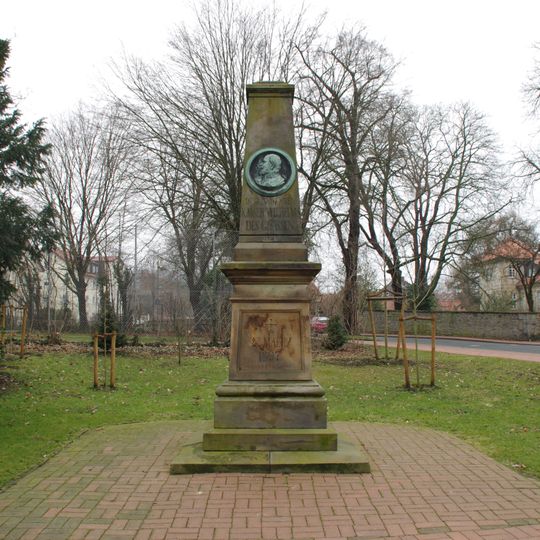
Altes Kriegerdenkmal, War memorial and heritage monument in Barsinghausen, Germany.
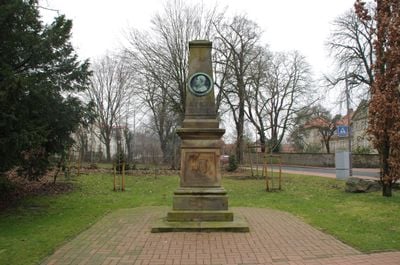
The Altes Kriegerdenkmal is an obelisk of Wealden sandstone on a multi-tiered pedestal with a square base, made by Barsinghausen master stonemason and local head August Gehrke. A round bronze medallion with a relief portrait of Kaiser Wilhelm I. decorates the east side, beneath it the inscription "DEM ANDENKEN KAISER WILHELMS DES GROSSEN". The north side of the pedestal reads "UND SEINEN TAPFEREN KRIEGERN", the south side "GEWIDMET VON DER GEMEINDE BARSINGHAUSEN".
The obelisk was erected on 22 March 1897, the 100th birthday of Kaiser Wilhelm I, in the centre of Barsinghausen at the Thie. In September 1951 it was moved to Bergamtstraße during a road widening. In 1929 the names of two Barsinghausen men who fell at the Battle of Langensalza on the Hanoverian side were added to the west side.
The obelisk's east face carries a bronze medallion of Kaiser Wilhelm I above the inscription "DEM ANDENKEN KAISER WILHELMS DES GROSSEN"; the north side adds "UND SEINEN TAPFEREN KRIEGERN". From around 1900 until the pre-war years, Barsinghausen's clubs held festivals and parades at the memorial, first on the Thie and after 1951 by the Ziegenteich.
The memorial is centrally located in town and can be reached on foot from the train station or main streets. The site is open and free to visit at any time, accessible in all weather conditions.
The bronze eagle that once crowned the obelisk was badly damaged by vandalism; repair attempts failed because the thin sheet metal crumbled, and the fragments, stored first in the town hall attic and later at the works yard, were eventually lost. In the early 1990s a stone replacement was discussed without result.
The community of curious travelers
AroundUs brings together thousands of curated places, local tips, and hidden gems, enriched daily by 93,737 contributors worldwide.