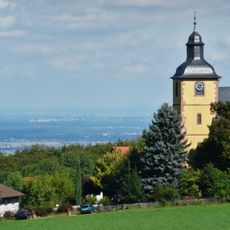
Heuneburg, Ancient fortification in Lichtenberg, Germany
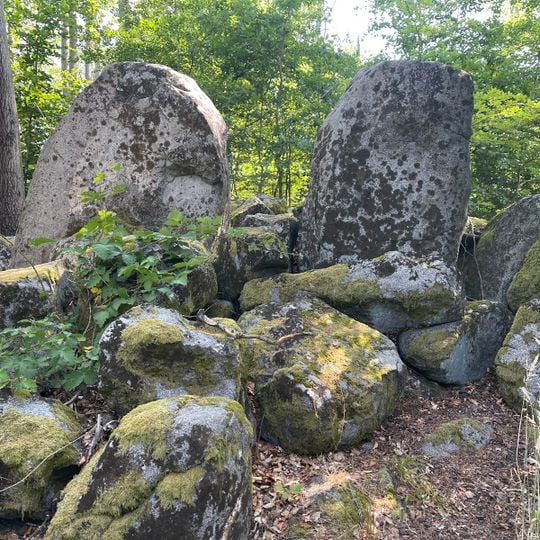
Heuneburg is a ring-wall enclosure on the summit plateau of the Altscheuer at 376.2 m in the Vorderer Odenwald, within the Fischbachtal municipality. Its main rampart was a dry-stone wall about 3 m thick, set without foundation directly on the rock, with a second section wall fronting it to the east and south. Granite blocks from the slope and from groups inside the enclosure were used to build the wall.
The rampart was first recorded in 1589 as "Quirnburg" in the Urbar of the Amt Lichtenberg. Investigations followed in 1842–43 under Johann Friedrich Knapp, before 1888 under Friedrich Kofler, around 1923 under Friedrich Behn, and in 1917 Eduard Anthes interpreted the main wall as a dry-stone wall about 3 m thick set directly on rock. Until the end of the 20th century the site was dated to the La Tène period; later reassessment based on Alamannic finds, including hand-made pottery, wheel-thrown sigillata and a chip-carved belt, led to its attribution to the 4th/5th century and to a Carolingian castle.
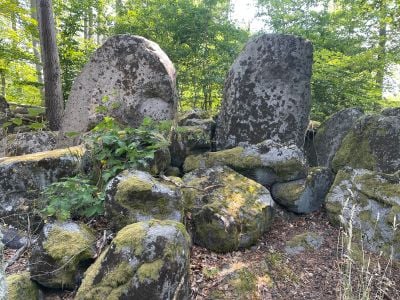
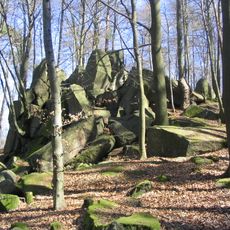
The name Quirnburg appears in the 1589 Urbar of the Amt Lichtenberg, the first written record of the site. Two gates were identified, each protected by a kidney-shaped forework and an outer ditch. Visitors can still see granite boulders inside the rampart, the same stone used to build the ring wall.
The site is accessible via marked hiking trails and sits at approximately 376 meters elevation. Information panels along the paths help visitors understand the fortification and its historical context.
The site was long read as an Iron Age hillfort, but since the late 20th century Alamannic finds — handmade pottery, wheel-thrown sigillata and a chip-carved belt — have led scholars to interpret it as a 4th/5th-century fortification and hill settlement, later a Carolingian castle. These conclusions rest on isolated finds only.
The community of curious travelers
AroundUs brings together thousands of curated places, local tips, and hidden gems, enriched daily by 94,660 contributors worldwide.