Wünschmann-Haus, Cultural heritage building in Leipzig, Germany.
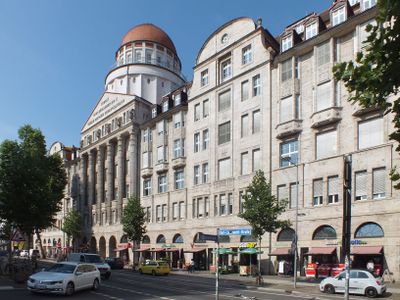
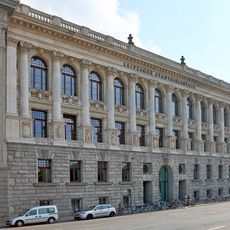
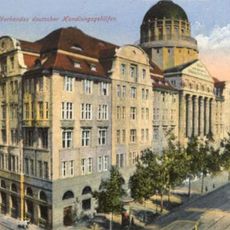
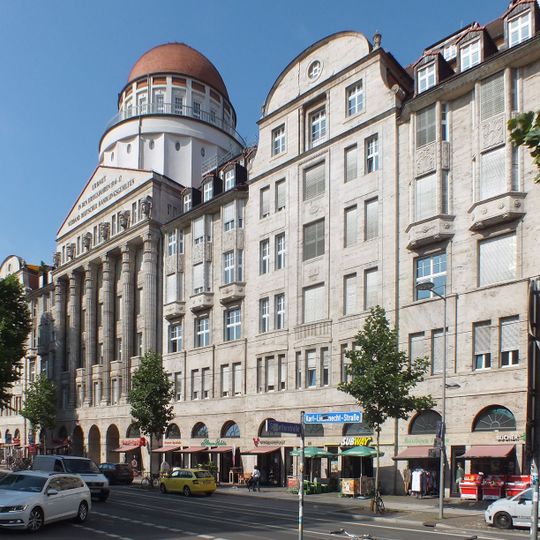
The Wünschmann-Haus is a five-storey residential and commercial building on Karl-Liebknecht-Straße, nearly 100 metres long with 23 window axes. Its travertine-clad facade has a portico-like centre with six fluted columns over four floors, topped by six large head figures and a triangular gable inscribed with its construction in the war years 1914–17. Three side wings enclose two inner courtyards, and a round hall about 18 metres across sits under a hemispherical dome reaching 47 metres.
Georg Wünschmann designed the building, erected from 1914 to 1917 for the Verband Deutscher Handlungsgehilfen, a forerunner of the salaried employees' union; the attic inscription names the association and the war years. From 1847 to 1861 part of the site held Moritz Schreber's orthopedic-gymnastic institute. The FDGB owned the house from 1946, and a renovation from 1993 to 1996 added a 60-space underground garage and 25 apartments.
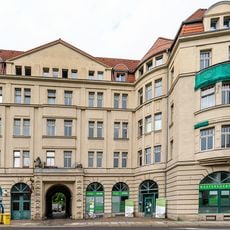
The name refers to architect Georg Wünschmann, who designed the building; it was originally called Haus Deutscher Handlungsgehilfen after its builder, the Verband Deutscher Handlungsgehilfen. Behind the three arched entrances of the central section lies an open entrance hall whose coffered ceiling carries six glass mosaics by Leipzig painter Arthur Michaelis. Until 1993 a post office operated in the counter hall behind it. Since 2024 the art association 47m Contemporary has used the upper floors for exhibitions of modern art.
The building runs nearly 100 metres along Karl-Liebknecht-Straße with 23 window axes, and three arched entrances in the central section lead into an open entrance hall. The travertine façade, the six columns and the dome rising 47 metres above street level are best seen from the public pavement. Ground-floor retail and the art association on the upper floors determine when you can go inside.
The round hall in the dome, about 18 metres across with twenty full-height windows, reaches 47 metres above street level and is still used for events. The building's name comes from its architect Georg Wünschmann, not from an early owner.
The community of curious travelers
AroundUs brings together thousands of curated places, local tips, and hidden gems, enriched daily by 93,729 contributors worldwide.