Castle Wernrode, Renaissance château in Wernrode, Bleicherode, Germany
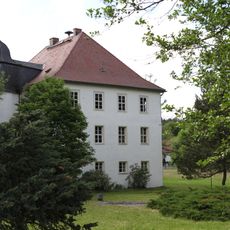
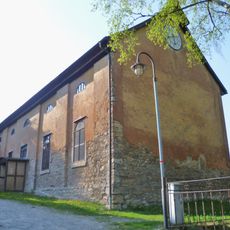
Schloss Wernrode is a former knight's estate in Wernrode, part of Bleicherode in Thuringia. Its two-story manor house at Teichstraße 41 was built around 1603 from rubble stone in plain Renaissance forms, with a steep saddle roof, small dormers, four plastered corner bay windows under pyramid roofs, and a round stair tower inside. A polygonal chapel annex stands to the south, and a pond north of the house may be the remnant of a moat.
The site has its origins in the 12th century when the nobility of Wernrode first established their presence in the area, while most structures visible today date to the Renaissance period. The current castle was built in the early 17th century and has defined the appearance of the estate since then.
The Trinity relief, kept in the manor house hallway until 1938, shows God the Father and the Son laying their hands on a globe, with the Holy Spirit as a dove above and an angel tuning a lute. A cartouche reads "Mein Hofnvng steht zv Gott, Margreta Jagemann geborne Deden" with the Jagemann coat of arms.
The grounds are easy to explore on foot since the site is manageable and buildings are arranged around the courtyard. The landscape park enclosed by stone walls and the former moat converted into a pond offer pleasant walking routes throughout the property.
The landscape park wall incorporates weathered relief slabs of Seeberg sandstone from the Upper Keuper (Rhaetian). Until 1938 the Trinity relief was set in the manor house hall; it shows God the Father and the Son laying hands on a globe, the dove of the Holy Spirit above, and an angel tuning a lute, with the inscription "Mein Hofnvng steht zv Gott, Margreta Jagemann geborne Deden."
The community of curious travelers
AroundUs brings together thousands of curated places, local tips, and hidden gems, enriched daily by 94,004 contributors worldwide.