Karsthans-Kirche, Protestant church in Täbingen, Rosenfeld, Germany
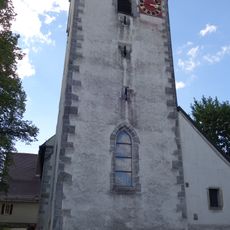
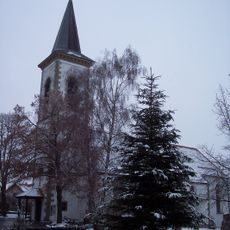
The Karsthans-Kirche in Täbingen is a rectangular gallery church built in 1834/1835 in late Neoclassical style, with a barrel-vaulted nave on tall wooden columns with Egyptianizing capitals and a U-shaped gallery. The medieval tower on the north side retains 15th-century Alemannic half-timbering and two large clock faces. The cream-colored east facade has a triangular gable, a round-arched window and a pilaster-framed doorway.
A wooden chapel stood on the site of the freehold of St. Georgen monastery as early as the 8th or 9th century; in the 11th century it was replaced by a Romanesque chancel-tower church dedicated to St. Blaise, renewed in the 15th century. Täbingen became its own parish in 1739, and the dilapidated chapel grew too small. The present church was built in 1834/1835 to designs by building inspector Carl Christian Nieffer, keeping the old tower; it was renovated in 1904 and 1967 and named Karsthans-Kirche in 1984 for the 150th anniversary, after the physician and itinerant preacher Hans Maurer, called Karsthans, through whom Täbingen joined the Reformation.
The name Karsthans-Kirche, adopted in 1984 for the 150th anniversary, honours Hans Maurer, called Karsthans, a physician and itinerant preacher through whom Täbingen joined the Reformation. The building serves the Protestant parish of Täbingen, Dautmergen and Zimmern unter der Burg; the organ, built in 1835 by Anton Braun of Spaichingen, is known as the "Tausendgüldenorgel".
The church stands in Täbingen, not Rosenfeld; the parsonage at Oberland 9 is a separate half-timbered building from 1712. The entrance is on the east side, with the altar and sacristy at the west. A footpath, the Kirchengässle, runs along the walled cemetery to the church. The tower's ground floor, once the choir of the St. Blaise chapel, holds a memorial mosaic from 1963.
The tower once served as a fortified watchtower and place of asylum for the village, and its ground floor was the choir of the medieval St. Blaise chapel; the former choral arch is still hinted at on the tower's west side. Since 1963 the renovated tower interior has held a memorial to the fallen, a mosaic by Wilhelm Pfeifer of Tübingen depicting the women at the empty tomb after the Resurrection, executed by the Täbingen tiler Hermann Huonker.
The community of curious travelers
AroundUs brings together thousands of curated places, local tips, and hidden gems, enriched daily by 94,240 contributors worldwide.