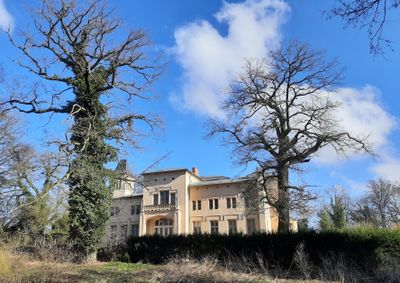
Schloss Krumke, Medieval castle in Krumke, Germany
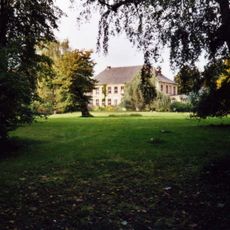
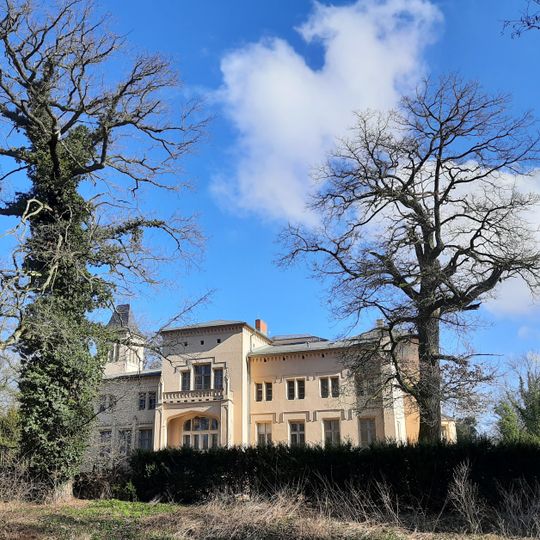
Schloss Krumke is a castle on a former island in the Biese floodplain at Krumke, now part of Osterburg in the Altmark. The present building was erected in 1854 after the castle moat was drained in 1853; around 1913 the old manor house was demolished and replaced on the same spot by today's cavalier house. The 12,000-square-metre park, laid out in the French style by the Paris garden architect Charles La Rond, surrounds the castle, and the complex with outbuildings is a listed monument and part of the Gartenträume Sachsen-Anhalt gardens.
A medieval moated castle of the von Redern family stood on an artificial island in the Krumme Beke stream; its remains were demolished before 1760. Christoph von Kannenberg acquired the estate in 1649 and had the orangery built, while Charles La Rond laid out the French garden (died 1719). The moat was drained in 1853 and a new castle built on the island in 1854. Arthur von Gwinner demolished the old manor around 1913 and replaced it with today's cavalier house.
The park's name recalls the stream "Krumme Beke", whose bend once enclosed the water castle on an artificial island. Two legends were recorded here: Heinrich Christoph Steinhart noted in 1802 a tale of General Christoph von Kannenberg's treasure, said to have been stolen from a tower, and Alfred Pohlmann in 1901 the story of Leopold von Kahlden, who died in Krumke on 11 February 1837 and is said to ride a headless white horse along the garden wall on moonlit nights.
Schloss Krumke stands at Parkstraße 1–9 and 11 in Krumke, now part of Osterburg. The castle itself has been empty since its sale in March 2020, so visits concern the surrounding grounds: the 12,000-square-metre garden and the Schlossinsel, which passed into private ownership in 2004. The site is listed as a heritage monument together with its outbuildings and park.
The park's oldest feature is its French-style layout, designed by Paris gardener Charles La Rond, who died at Krumke in 1719. A plan drawn in 1724 by Friedrich Wilhelm von Kannenberg already shows a rectangular garden close to the later baroque arrangement. The 12,000 square metres were tended by hand by the owners after 2004.
The community of curious travelers
AroundUs brings together thousands of curated places, local tips, and hidden gems, enriched daily by 93,997 contributors worldwide.