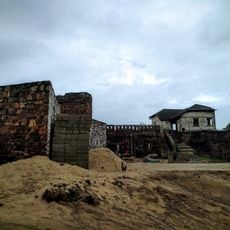
Fort Sekondi, English fort ruins in Sekondi-Takoradi, Ghana
Fort Sekondi was an English fort built in 1682 at Sekondi, a gun-shot from the Dutch Fort Orange. A 1772 plan by surveyor William Smith shows a large square work with corner bastions, extra-reinforced ramparts facing Fort Orange, and an inner fortification dominated by a central tower. Few traces remain today.
Fort Sekondi was an English fort built in 1682 by the Royal African Company, with the consent of local leaders, close to the Dutch Fort Orange. It was destroyed on 1 June 1698 during the Dutch-Komenda war; a second fort, drawn by surveyor William Smith in 1772, was taken and destroyed by the Dutch in 1782. Transferred to the Dutch in 1868, it returned to Britain in 1872 and was never rebuilt.
The fort's name survives in the town: Sekondi was recorded earlier as Zakonde and Secondee. When the Dutch noticed the English station going up in 1682, they accused the local leaders of betrayal, insisting on an exclusive trade right, and withdrew to Fort Witsten in Takoradi. They soon returned at the request of Sekondi's representatives, who argued trade conditions were better there.
A visit is best planned for dry weather since the ruins sit on the exposed coast. The site's proximity to local markets means you can easily combine a tour with exploring the surrounding commercial life of the town.
The fort was reconstructed multiple times as it passed between Dutch and British control. This contested history has left behind only scattered remains rather than a fully intact structure.
The community of curious travelers
AroundUs brings together thousands of curated places, local tips, and hidden gems, enriched daily by 94,149 contributors worldwide.