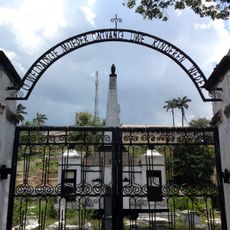
Elmina Castle, Portuguese colonial fort in Elmina, Ghana.
Elmina Castle is a white stone complex on a narrow promontory between the Atlantic and the Benya River in Ghana, with high walls and several towers to protect the garrison. Narrow passageways connect the rooms inside, while the upper floors offer views of the ocean and riverbank.
King John II of Portugal sent a prefitted stone and tile kit on eleven ships under Diogo de Azambuja, who landed on 19 January 1482 and raised the castle within weeks. It anchored the gold trade until the Dutch West India Company seized it in 1637, then held captives for the Atlantic slave trade until 1814. Britain took over the Dutch Gold Coast in 1872, and independent Ghana has controlled the castle since 1957.
The castle's name comes from the Portuguese "A Mina" (the Mine), after the gold trade that drew Fernão Gomes there in 1471. Under the fort grew the settlement called "Duas Partes", one part European, one native, which received its charter in 1486. Trade goods exchanged here included wheat, cloth, horses and zimbo shells, traded for gold and, increasingly from the 16th century, slaves.
Visits take place daily from 9 AM to 4:30 PM and lead through basement rooms, cells, and the historic door of no return. The tour lasts about an hour, with sturdy footwear recommended due to uneven flooring.
Next to the main rooms lie small chambers that once served as storage for trade goods and still show their original stone arches today. Visitors often notice that the walls have different thicknesses, depending on whether they face the sea or the land.
The community of curious travelers
AroundUs brings together thousands of curated places, local tips, and hidden gems, enriched daily by 92,800 contributors worldwide.