Cape Coast Castle, Historical fortification in Cape Coast, Ghana
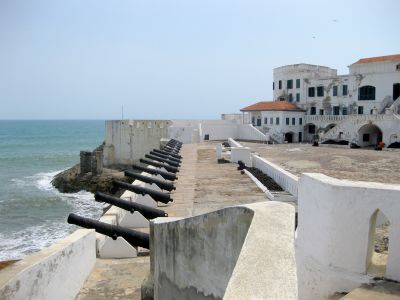
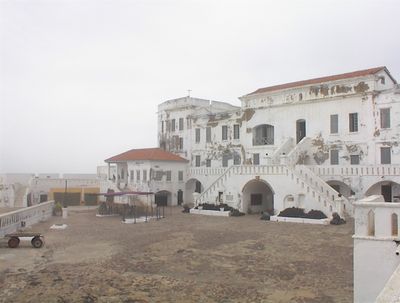
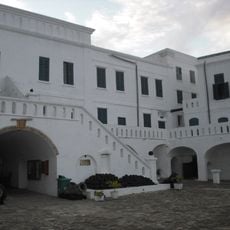
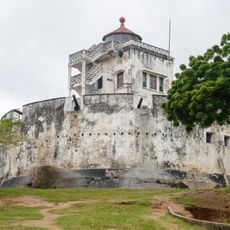
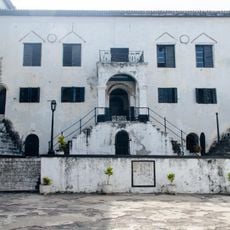
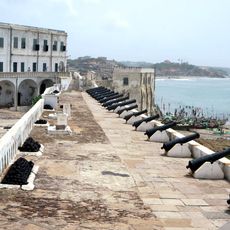
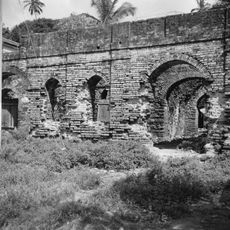
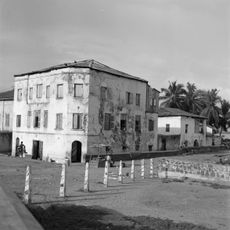
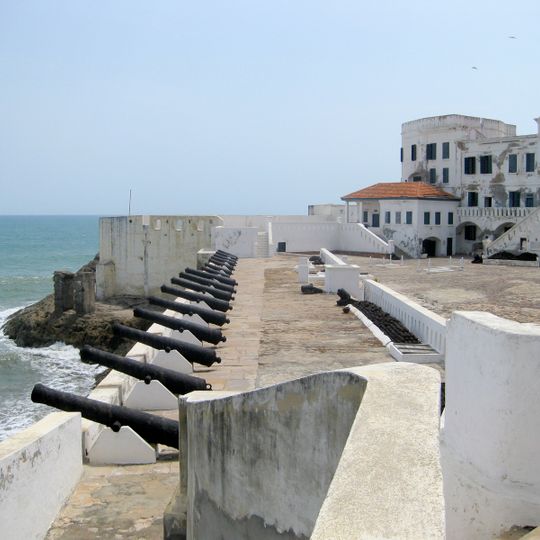
Cape Coast Castle is a whitewashed stone fort on the Cape Coast shoreline, with a broad paved terrace lined with black iron cannons on white concrete blocks and a pile of cannonballs. The main building has a weathered white facade, green shutters and a red-tiled roof; a taller block with an arched doorway and two curving white balustraded staircases faces the uneven stone-paved ground.
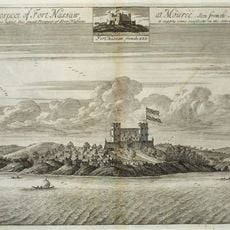
A Portuguese trading post called Cabo Corso stood here from 1555. In 1653 the Swedish Africa Company built a timber fort named Carolusborg; the local Fetu captured it in 1660–1663, and it passed to Denmark in 1659 and to Britain in 1665. On 28 March 1722, 95 crew members of Bartholomew Roberts were tried here for piracy, and 52 were sentenced to hang.
The Ghana Heritage Trust runs a museum inside the castle on the history of the slave trade on the former Gold Coast. The castle's name comes from Cabo Corso, Portuguese for "Short Cape", given to the 1555 trading post. Visitors pass through the former dungeons cut into the rock beneath the parade ground, where captives were held before being led through a narrow cellar passage to the beach for loading.
Tours of the fort run daily from 9 AM to 4:30 PM, allowing visitors to explore the dungeons, towers, and museum sections with professional guides. The underground areas can be narrow and dark, so visitors should wear sturdy shoes and watch for uneven steps.
On 28 March 1722, Cape Coast Castle hosted one of the most notorious piracy trials in British Admiralty history: 95 crew members of Bartholomew Roberts were convicted, and 52 were sentenced to hang. The castle's dungeons were cut into the rock beneath the parade ground, and their building date is not recorded.
The community of curious travelers
AroundUs brings together thousands of curated places, local tips, and hidden gems, enriched daily by 92,693 contributors worldwide.