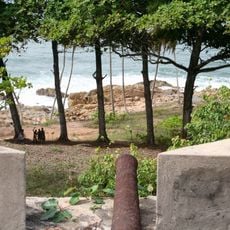
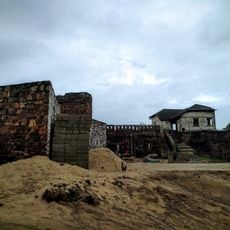
Fort Batenstein, Dutch colonial fort in Butre, Ghana.
Fort Batenstein stands on a hill above the fishing village of Butre, about three kilometres from Busua on Ghana's Atlantic coast. The Dutch West India Company completed the fort by 1656. It has been a ruin for decades and was extensively restored under an Italian professor with local help, so it remains a ruin but in better condition. Since 1979 it has been a UNESCO World Heritage Site.
The Dutch West India Company built Fort Batenstein by 1656 on a hill above Butre bay, not for trade but to prevent the Swedish Africa Company from returning after its lodge was attacked in 1652. The Treaty of Butre with the Ahanta was signed there on 27 August 1656. In 1837 the Dutch–Ahanta War made it the centre of Dutch military effort, and the commandant became vice governor of the Ahanta protectorate. Britain took over in 1872 and shelled Butre in October 1873 after protests.
The fort served as a meeting point where European merchants and local communities conducted daily business and built relationships. The site shows how two distinct worlds came together at the coast and influenced each other.
Visitors are best served by hiring a guide from the nearby village to navigate the route and explain the site. It is wise to wear sturdy shoes, as the paths are rough and stairs can be steep.
The site hosted a sawmill in the 1700s that supplied timber for ship repairs and construction along the Gold Coast. This workshop reveals how Europeans developed their settlements using local resources.
The community of curious travelers
AroundUs brings together thousands of curated places, local tips, and hidden gems, enriched daily by 94,218 contributors worldwide.