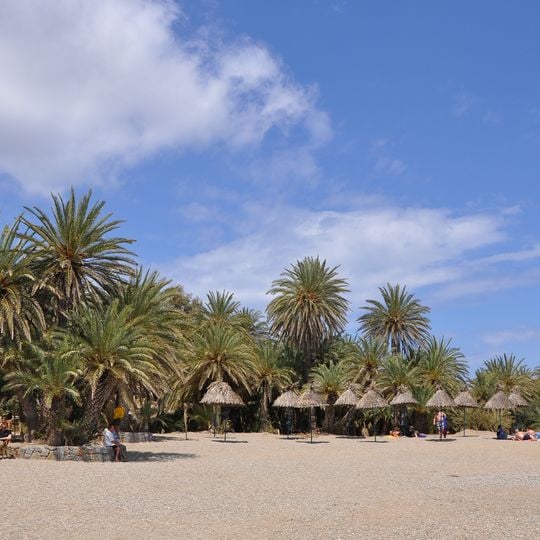
Palm forest of Vai, Palm forest and beach in eastern Crete, Greece
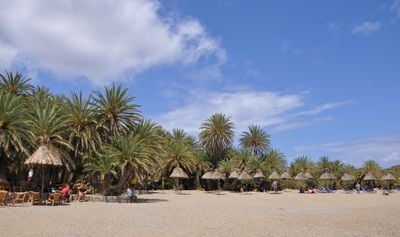
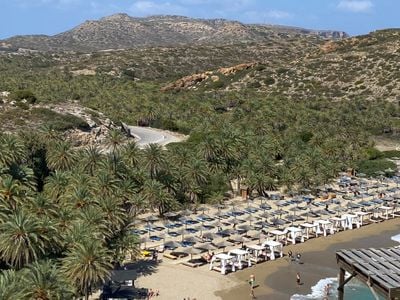
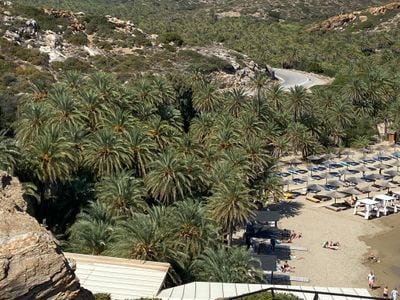
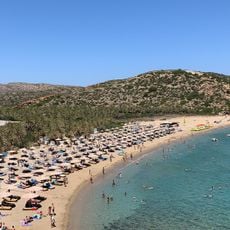
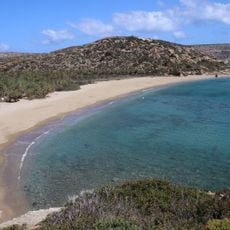
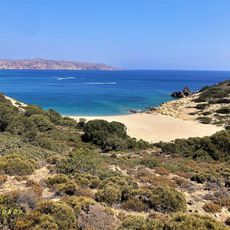
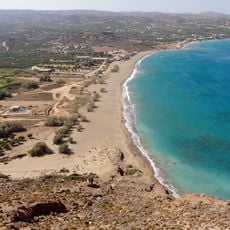
The palm forest of Vai fills a valley that runs down to the beach at the Grandes bay, on Crete's eastern coast. Thousands of Cretan date palms (Phoenix theophrasti) with thick fibrous trunks and bright green fronds form a grove behind the shore, where rows of thatched sun shelters stand on pebbly ground. Only a narrow strip at the beach edge is open to visitors; the rest of the forest is fenced off.
Vai was 'discovered' in the 1970s by hippies who moved east from Matala and Preveli. By the mid-1970s the beach had become a chaotic campsite and rubbish dump, so the authorities fenced the area, declared it a nature reserve and expelled wild campers. The palm grove, owned by Toplou Monastery, recovered and now draws thousands of day visitors a year.
The name Vai is the Greek word for "palm". A local legend says pirates hiding here threw away the stones of eaten fruit, from which the grove grew; the Cretan date palm's fruit is barely edible, so the tale does not hold. The land belonged to Toplou Monastery, and restaurants along the road still give their address as Toplou.
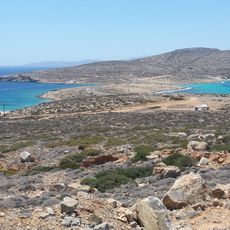
The area lies east of Sitia and is accessible via a direct road with parking spaces. Visitors should expect sunny and open terrain, so sun protection is advisable.
The palm is Phoenix theophrasti, named by Swiss botanist Werner Greuter in 1967 after Theophrastus, who described it around 300 BC. A local legend says pirates spat out date stones here, but the Cretan date palm's fruit is barely edible, so the tale does not hold.
The community of curious travelers
AroundUs brings together thousands of curated places, local tips, and hidden gems, enriched daily by 92,796 contributors worldwide.