Acronauplia, Medieval fortress in Nafplio, Greece.
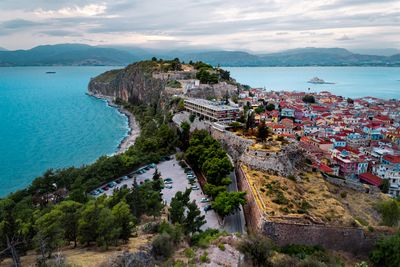
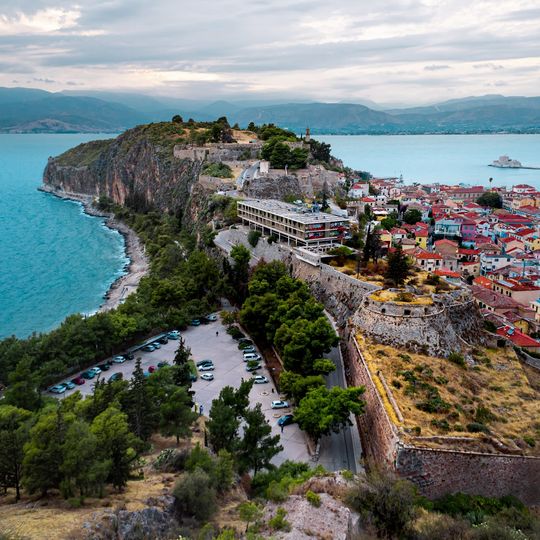
Acronauplia is a fortress in Nafplio, Greece, built on a rocky promontory that juts into the sea and is ringed by thick stone walls and defensive towers. The site sits on multiple levels that follow the natural contours of the rock below.
Acronauplia was the oldest part of Nafplion and remained a town in its own right until the 13th century, when Venetians and Franks turned it into part of the town fortifications. In 1502 the Venetians added a northeastern tower facing Palamidi and a western bastion with five equal cannons called the "Five Brothers", giving the castle that name. The Ottomans took Nafplion in 1540, strengthened the fort with larger cannons and called it Iç Kale, the inner castle. On the night of 30 November 1822 Greeks under Staikos Staikopoulos captured Palamidi and bombarded Acronauplia; three days later the Turks surrendered the castle to Theodoros Kolokotronis.
The stonework at Acronauplia changes noticeably as you move through the site, shifting from Byzantine masonry to Frankish additions and then Venetian reinforcements. Each section tells you something about who controlled this rock and how they chose to defend it.
The site is easy to reach on foot from the center of Nafplio, and stone steps and pathways connect the different levels of the fortification. Wear sturdy shoes, as the paths can be steep and the stone surfaces are often uneven.
The castle's three walled sections are named: the western Romeiko, the central Frangiko with Nafplion's clock tower at its north end, and the eastern Toron, whose southeastern tip holds the Sea Gate. The Frankish cross-wall Cambello divides the central section, and the Grimani bastion lies further east.
The community of curious travelers
AroundUs brings together thousands of curated places, local tips, and hidden gems, enriched daily by 94,241 contributors worldwide.